


 By Leonardo Gambacorta, Head of Emerging Markets Unit, Bank for International Settlements (BIS), and Livia Pancotto, Senior Lecturer in Banking, University of Strathclyde
Climate change has implications for central banks. Extreme weather-related shocks are increasingly shaping growth outcomes, inflation dynamics and financial conditions across the global economy, with direct implications for near-term policy decisions. These events, rising temperatures and the uncertain path of the transition to a sustainable economy are interacting with traditional macroeconomic drivers, adding new layers of complexity to the conduct of monetary policy and the safeguarding of financial stability.
It reflects the need to continue fulfilling existing monetary and financial stability responsibilities in an environment characterised by more frequent supply disruptions and heightened uncertainty.
For central banks, the relevance of climate change does not lie in expanding mandates or redefining objectives. Rather, it reflects the need to continue fulfilling existing monetary and financial stability responsibilities in an environment characterised by more frequent supply disruptions and heightened uncertainty. Such risks, both physical and transition, are starting to materialise within policy-relevant time horizons, potentially affecting inflation, output and balance sheets, with implications for policy effectiveness.
Physical risks arise from acute events such as floods, storms, droughts, wildfires and heatwaves, as well as from slower-moving shifts in climate patterns, including rising average temperatures and water scarcity. These risks can disrupt production, damage infrastructure, reduce labour productivity and impair supply chains. Often, also depending on the type of event, their immediate macroeconomic footprint closely resembles that of negative supply shocks, putting upward pressure on prices while weighing on economic activity; demand effects can also be significant, depending on income losses, reconstruction activity and the availability of insurance or fiscal support. In contrast, transition risks stem from the policy, technological and market adjustments associated with the move towards a sustainable economy. Changes in energy pricing, regulation and investment patterns can alter relative prices, affect production costs and reshape financial valuations. While a well-signalled and orderly transition can support investment, innovation and long-term growth, delayed or abrupt adjustments tend to increase volatility, amplify uncertainty and heighten financial-stability risks.
These risks interact directly with the transmission mechanisms of monetary policy and the financial system’s resilience. Extreme weather-related shocks are often non-linear, correlated and state-dependent, meaning they amplify existing vulnerabilities and macro-financial feedback loops. They can therefore influence asset valuations, credit conditions and risk premia, with implications for both financial stability and policy transmission.
From a financial-stability perspective, extreme weather-related risks can weaken the balance sheets of households, firms and sovereigns, increasing credit risk and straining financial intermediation. Physical shocks may reduce repayment capacity and raise default risk, particularly when losses are uninsured and recovery relies heavily on domestic resources. Transition dynamics can also trigger abrupt asset repricing, especially in carbon-intensive sectors, with implications for banks’ loan portfolios and market exposures. Where exposures are concentrated, these effects may propagate through the financial system and can slow the macroeconomic recovery.
For monetary policy, climate change poses difficult trade-offs. Extreme weather events can cause temporary increases in headline inflation, often in food and energy prices, while simultaneously depressing output by destroying capital or reducing productivity. The appropriate policy response depends on the expected persistence of price pressures, the anchoring of inflation expectations and the relative strength of supply and demand effects. Work by central banks coordinated through the Network for Greening the Financial System (NGFS) highlights that climate-related shocks can operate through multiple channels and that their implications for inflation and output can be state-dependent. In this context, mechanical policy responses based solely on headline inflation may be ill-suited to a world in which weather-related shocks are larger and more frequent with non-transitory effects.
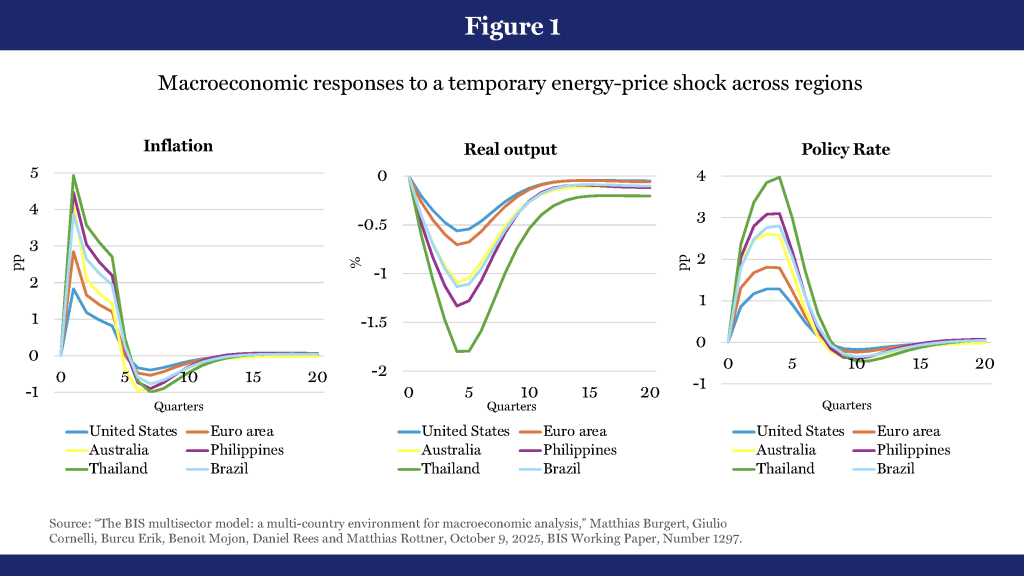
These trade-offs are illustrated by the Bank for International Settlements’ (BIS) modelling, which explicitly captures sectoral interdependencies and cross-border spillovers. Figure 1 shows the simulated effects of a temporary increase in fossil-fuel energy prices across major regions. The shock leads to a rapid increase in inflation, reflecting higher production costs in energy-intensive sectors and their pass-through along supply chains, while simultaneously weighing on real economic activity through lower real incomes and higher input costs. The results underscore that weather- and energy-related shocks can push inflation up and output down simultaneously and that the magnitude and persistence of these effects vary meaningfully with energy intensity and sectoral composition, highlighting the need for country-specific policy calibration.
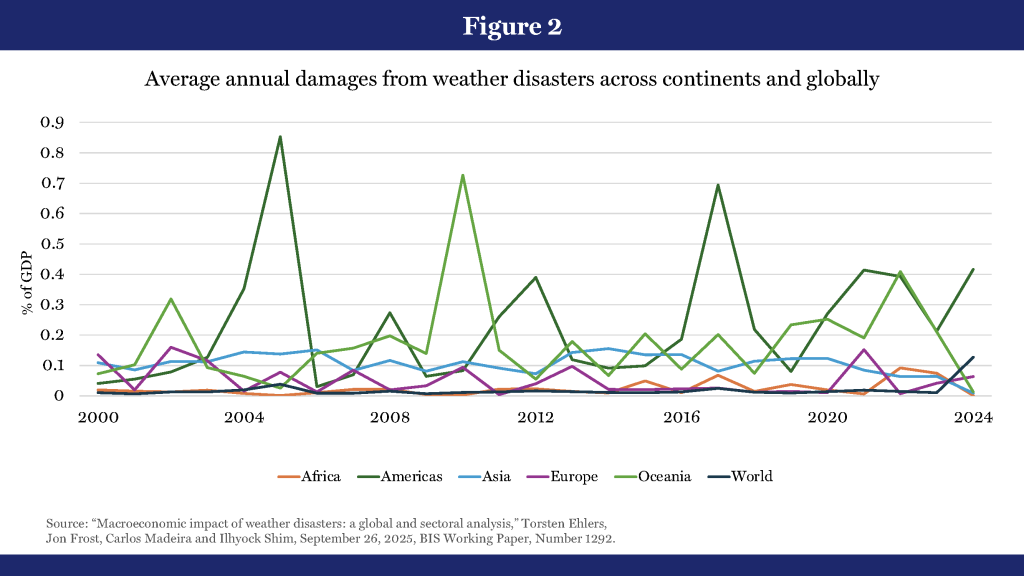
Empirical evidence also clarifies the scale and recurrence of weather-related shocks. Figure 2 shows the economic damage from climate-related disasters across regions over time, expressed as a share of gross domestic product (GDP). Climate-related losses are economically material even at the aggregate level, with repeated spikes reflecting major disaster years rather than isolated tail events. For central banks, this pattern signals a shift in the macroeconomic environment: Climate shocks are recurring sources of volatility that interact with inflation dynamics, growth and financial conditions and therefore warrant systematic consideration in macroeconomic assessment and risk analysis. Macroeconomic volatility may increase over time and amplify economic and financial losses as physical risks intensify and adjustments become more abrupt, with broader consequences for economic welfare, especially in the most vulnerable economies.
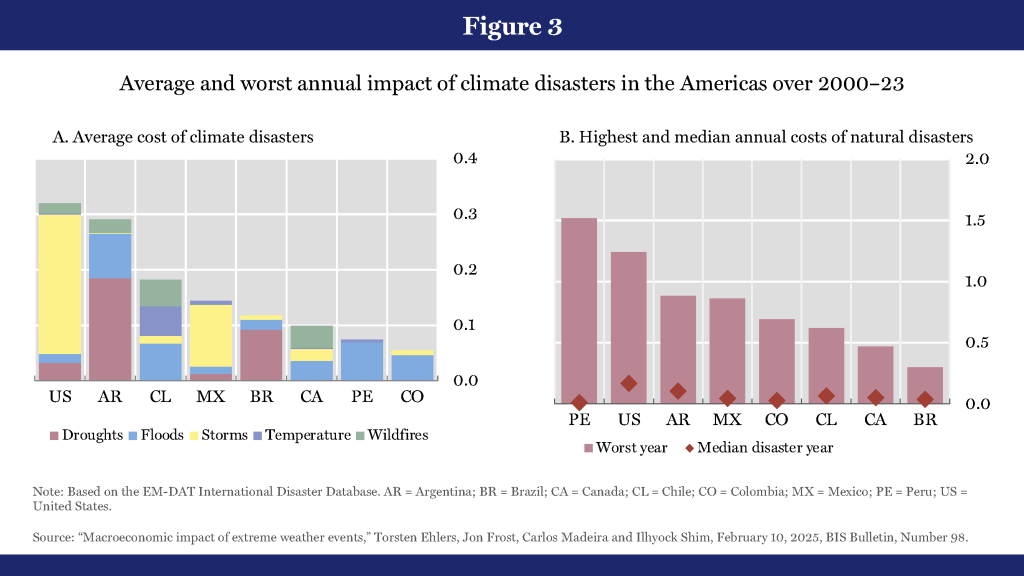
More granular BIS evidence, using the Americas as an empirical laboratory, shows that transmission depends critically on the type of event. Droughts tend to have more persistent negative effects on economic output than other types of extreme events, reflecting lasting damage to agriculture, forestry and electricity production, particularly in economies with significant reliance on hydropower or climate-sensitive primary sectors. By contrast, although food and energy prices often rise following droughts, storms or wildfires, these inflationary effects are typically short-lived and do not translate into persistent core inflation. Figure 3 illustrates the economic costs of climate disasters across eight major economies in the Americas.
The experience in the Americas also highlights the importance of insurance coverage and fiscal capacity in shaping macroeconomic outcomes. Where insurance gaps are large and fiscal space is limited, climate shocks are more likely to weaken balance sheets, strain public finances and amplify financial stress. These features are not confined to any one region, yet they underscore how climate risks can interact with the structural characteristics of economies to influence monetary and financial stability.
Beyond policy calibration, extreme weather events also have implications for central banks’ operations and risk management.
Beyond policy calibration, extreme weather events also have implications for central banks’ operations and risk management. Physical risks can disrupt payment systems, cash distribution and market functioning, while transition risks can affect the valuation of assets held on central banks’ balance sheets or accepted as collateral. In response, central banks have begun to incorporate climate considerations into their risk-management practices and analytical toolkits and to assess their relevance for operational frameworks, while remaining firmly within their mandates. Experience across major central banks illustrates how climate- and nature-related risks are increasingly being integrated into institutional risk assessments and day-to-day processes (with scope and modalities varying across jurisdictions) as part of broader efforts to enhance resilience.
A key analytical challenge underpinning these developments is that climate-related risks are characterised by deep uncertainty, non-linear dynamics and long horizons, features that traditional macroeconomic models, largely designed to analyse marginal, short-lived shocks around a stable equilibrium, were not built to capture. This has prompted growing interest among central banks in complementary approaches that combine macroeconomic analysis with sectoral, network-based and empirical insights, supported by advances in data availability, geospatial information and computational methods.
The challenge ahead is not to redefine central banks’ mandates, but to ensure that existing objectives can be met in a world characterised by greater uncertainty. This will require sustained investments in data, models and expertise, along with clear communication, as central banks adapt their frameworks to remain credible and resilient.
Disclaimer
The views expressed in this article are those of the authors and not necessarily those of the Bank for International Settlements.
Leonardo Gambacorta is the Head of the Emerging Markets Unit at the Bank for International Settlements (BIS). His main interests include monetary transmission mechanisms, the effectiveness of macroprudential policies on systemic risk and the impact of technological innovation on the financial system.
Livia Pancotto is a Senior Lecturer in Banking at the University of Strathclyde and currently a Visiting Economist at the Bank for International Settlements (BIS). Her research focuses on empirical banking, financial intermediation and financial stability in Europe.