

 By Anand Radhakrishnan, Senior Director-Industry Practice Lead, Moody’s
Banks increasingly need to assess and manage the risks and consequences of climate change on the credit quality of their obligors. Climate risks can pose threats to earnings, profit margins and debt-servicing capacity, especially for firms with significant footprints in high-carbon-emitting, or brown, industries. As climate-related risks increasingly influence borrowers’ credit-risk profiles, risk-based pricing models must be reshaped to incorporate these factors.
How should banks approach this task, which issues will most affect the outcomes, and what are the benefits? We examined these key factors using a sample global portfolio of 1,200 public firms to provide some insights.
Introduction
Companies face climate-related risks from both physical damage and disruption to business models due to the transition to a low-carbon economy. Extreme weather events, sea-level rises and transitioning to a low-carbon economy can disrupt industries, increase default risks and affect asset valuations. Organizations also face risks from policy changes such as carbon taxes, new regulations and shifting market preferences towards sustainability.
These risks vary by time, location, sector and company characteristics, with impacts differing across warming scenarios, necessitating scenario-based analyses of climate risks and impacts.
Most banking supervisors now require banks to identify, quantify and report exposures to climate threats. Many regulators also carry out stress tests to assess the financial sector’s resilience to climate risks and how the financial system may support a low-carbon future governed by international initiatives such as the United Kingdom’s Net Zero 2050 and the European Union’s Fit for 55. While supervisors have so far refrained from including climate risks in expected credit loss (ECL) and capital requirements, there is no denying that climate risks influence corporate performance and credit quality.
Impositions of carbon taxes will further influence corporate performance and credit quality. Europe and North America have led the way with carbon taxes and emissions trading systems (ETSs), but emerging economies are exploring similar mechanisms. The share of global emissions covered by carbon taxes and ETSs grew to around 23 percent in 2023 from 7 percent in 2012, according to the World Bank1. Government revenues from carbon taxes and ETSs rose nearly fivefold over the 10 years from 2013. While financial markets have started to price in some climate risks, especially acute physical risks, the market prices of instruments do not yet reflect the full range of climate risks2.
A robust, climate-sensitive risk-based pricing framework can help banks align with regulatory, investor and business expectations—and gain other benefits.
Climate-aware risk-based pricing
Risk-based pricing enables banks to align loan terms with the credit-risk profiles of individual borrowers. Typical risk-based pricing models compare net revenue (adjusted for expected credit losses, cost of capital, operating expenses, etc.) against the amount of capital the bank must set aside to cover unexpected losses associated with lending.
Many financial institutions have moved towards estimating the risk-adjusted return on capital (RAROC) over the lifetime of an exposure. This allows them to evaluate risks that may not materialize within a single year but could significantly impact risk-adjusted profitability over the life of a loan or investment. One such risk is the potential for stage transition under IFRS 9 (International Financial Reporting Standard 9), whereby significant deterioration in ratings or default probabilities can necessitate holding lifetime provisions instead of 12-month provisions for healthy credits. Provisions are based on scenario-conditional probability of default (PD), loss given default (LGD) and exposure at default (EAD).
The Basel Committee on Banking Supervision’s (BCBS’s) Basel framework’s risk-weighted asset (RWA) formula calculates the amount of capital that a bank is required to hold to cover unexpected losses. For institutions following the internal ratings-based (IRB) approach3, RWA calculations depend on PD (one-year through-the-cycle), LGD (downturn) and EAD.
The key to incorporating climate risks into risk-based pricing frameworks is to understand the impacts of physical and transition risks on PDs and LGDs, which, in turn, can be plugged into risk-based pricing frameworks.
Asset-class specificities
Methods to assess climate risk vary by asset class. For corporate portfolios, most current methodologies involve (i) compiling climate scorecard-based analysis to incorporate climate impacts on ratings, (ii) estimating climate-induced changes to expenses and capital expenditures on corporate earnings and running resultant financials through rating models to produce climate-adjusted ratings and/or (iii) forecasting climate-adjusted PDs4 using structural models such as Moody’s Public Firm Expected Default Frequency (EDF) model.
For asset classes such as commercial real estate (CRE), mortgages and corporate exposures secured by real assets, methodologies focus on climate-induced changes to valuations and property yields. The analyses evaluate the direct and indirect physical damages that an asset might suffer, as well as transition risks in the form of carbon taxes or restrictions on letting out properties with emissions exceeding regulatory limits. These risks play out in the form of changes to net operating income (NOI) or valuations—or, in some cases, additional retrofit costs to improve the energy efficiency of the property. Analytical models are used to derive updated valuations and net operating incomes, which, in turn, are used to generate climate-adjusted loan-to-value (LTV) and debt-service coverage ratios (DSCR), which are typical factors in most PD and LGD models.
The focus of this article is on examining how changes in PDs influence risk-based pricing for a corporate portfolio. A sample global portfolio of 1,200 public firms with annual revenues exceeding US$10 billion, covered by Moody’s Public Firm EDF model, has been analyzed.
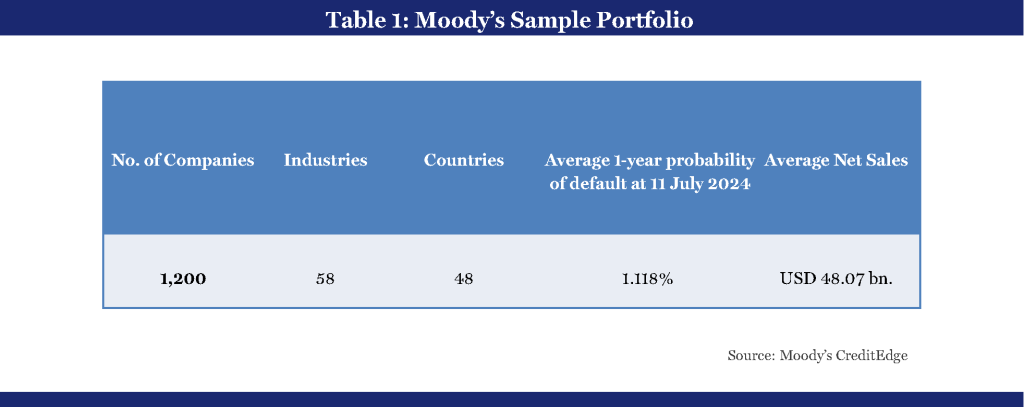
The data spans 58 sectors, with the largest representations from banks and financial institutions, business services and utilities, and electricity companies.
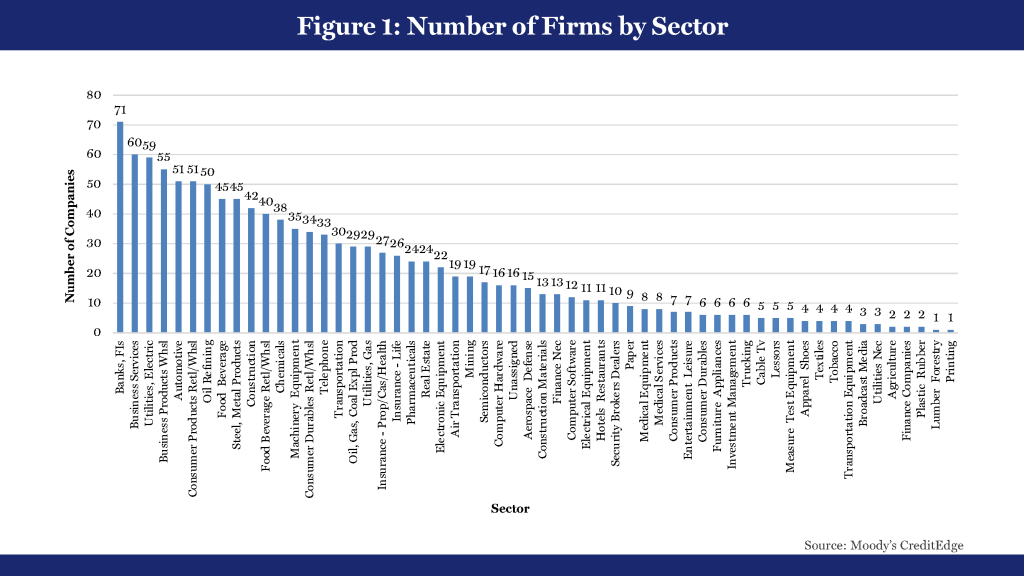
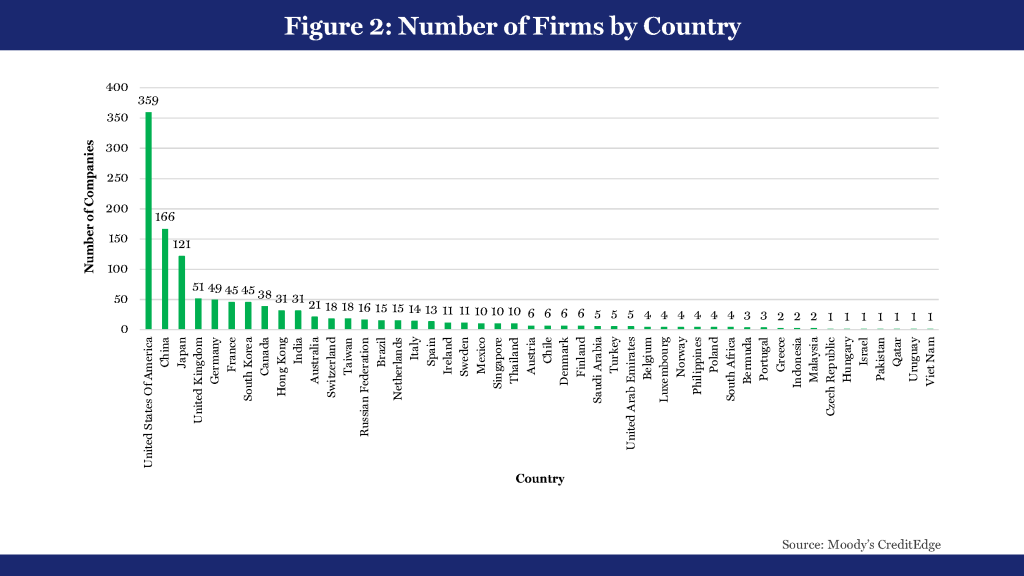
While the sample includes only large firms and might not adequately represent smaller firms, there is a fair dispersion across sectors in the dataset.
Using Moody’s climate-adjusted PD framework that integrates Network for Greening the Financial System (NGFS) scenarios5 to project physical and transition risks, we assessed and aggregated the firms’ PDs at sector and regional levels to indicate changes in PDs under different climate scenarios.
Figure 3 depicts the combined effect of physical and transition risks on the forecast PD term structure and relative changes in PDs for the entire portfolio. For this portfolio, beyond the 10-year horizon, the Disorderly Transition scenarios show the highest jump in PDs.
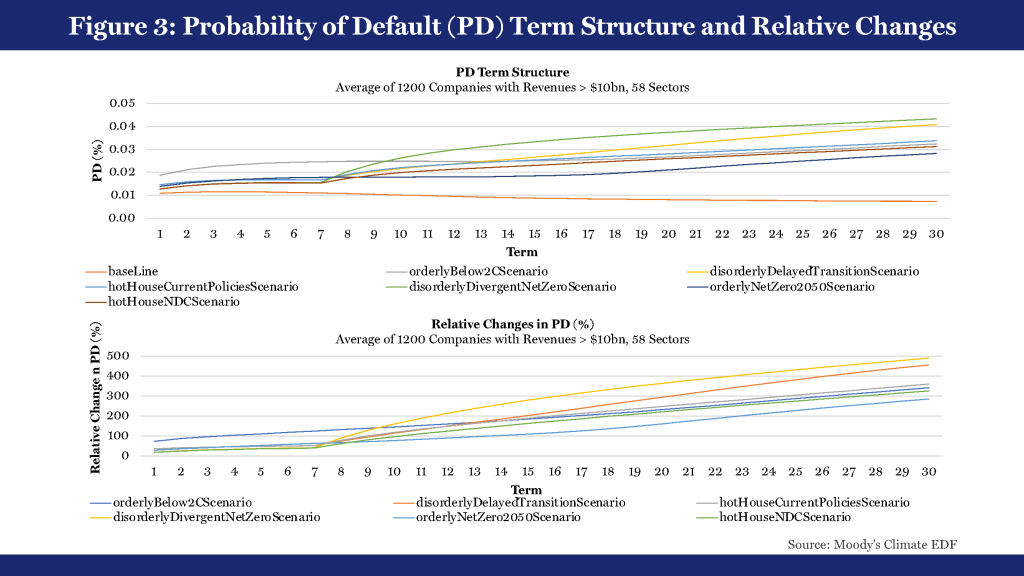
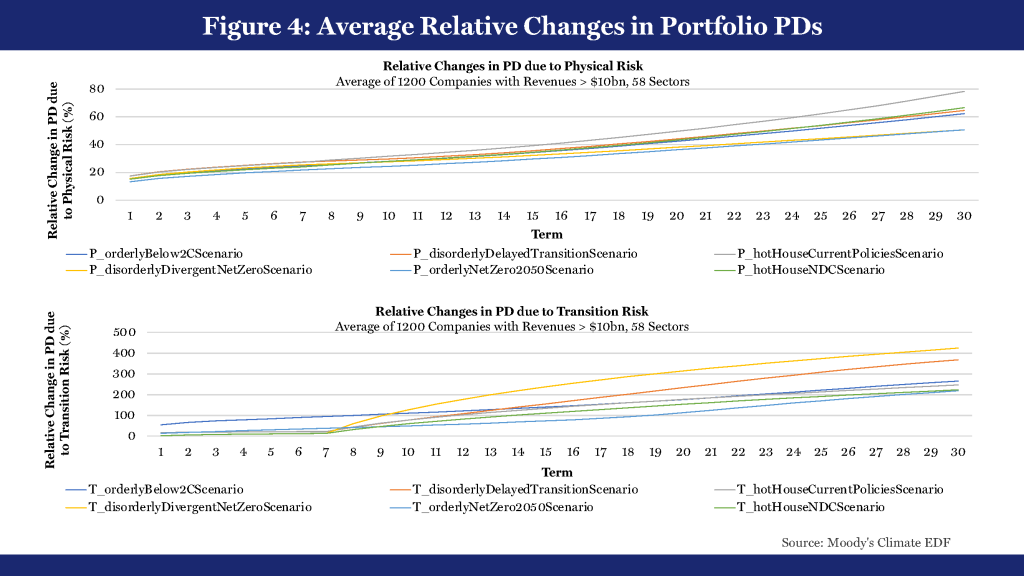
Figure 4 shows the average relative changes in portfolio PDs driven by physical risk and transition risk under NGFS scenarios for the firms in our sample.
Sectoral variations
The effects of climate scenarios on PDs vary across sectors and over time, underscoring the need for nuanced, sector-specific assessments, as shown in Figure 5.
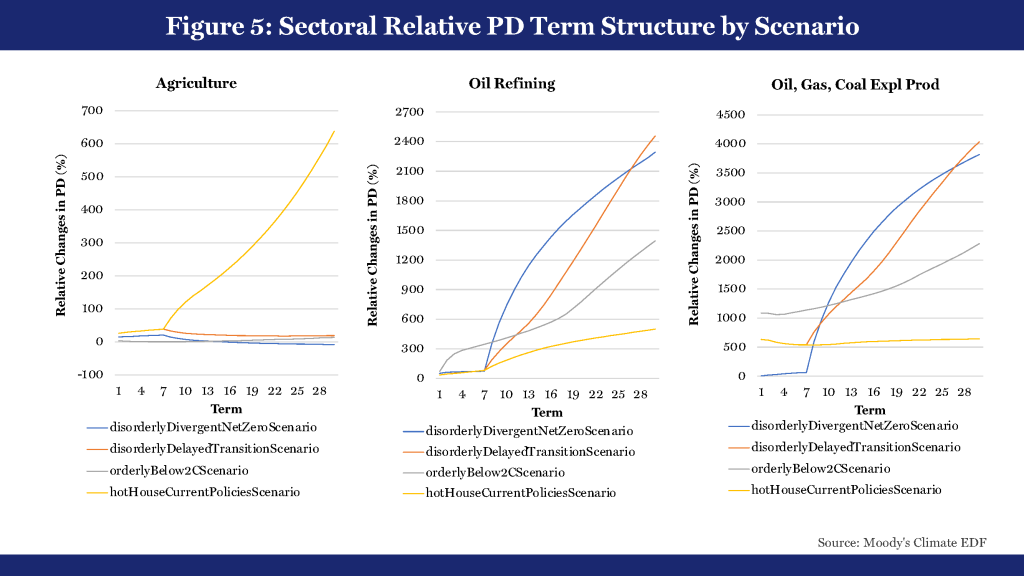
Oil-refining and exploration sectors benefit in a Hot House scenario with continued fossil-fuel usage in a warming world but face higher credit risks (and PDs) in Disorderly Transition scenarios due to delayed or divergent transition regulations and high carbon taxes.
Conversely, agriculture suffers from a Hot House scenario with severe physical risks, including irreversible impacts such as sea-level rises and water stresses resulting in declining arable land and agricultural yields, while it is relatively unaffected under the other scenarios.
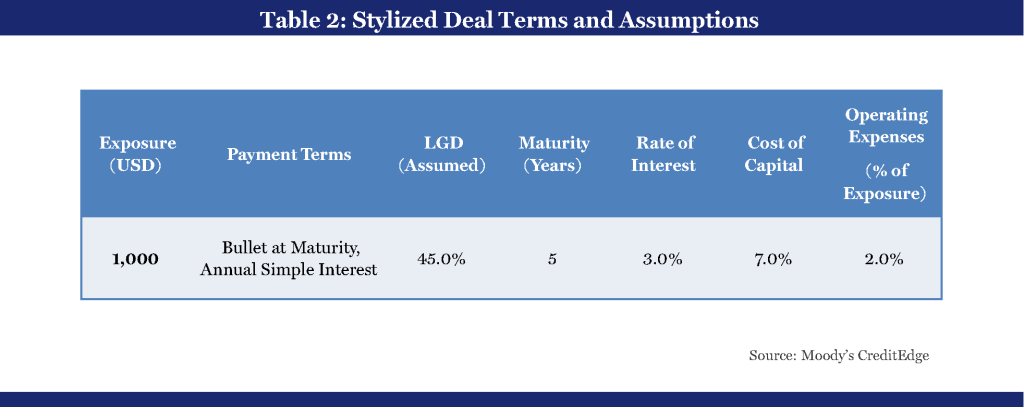
To illustrate the impact of climate-adjusted PDs on RAROC, a stylized example was created. In this example, two firms, each from a different sector, are granted a facility, as shown in Table 2.
We have calculated an annualized RAROC for the two firms based on the terms shown in Table 2. Company 1 is in the oil-and-gas exploration and production sector, while Company 2 is in the real-estate sector. The results for the five-year term are summarized in Table 3.
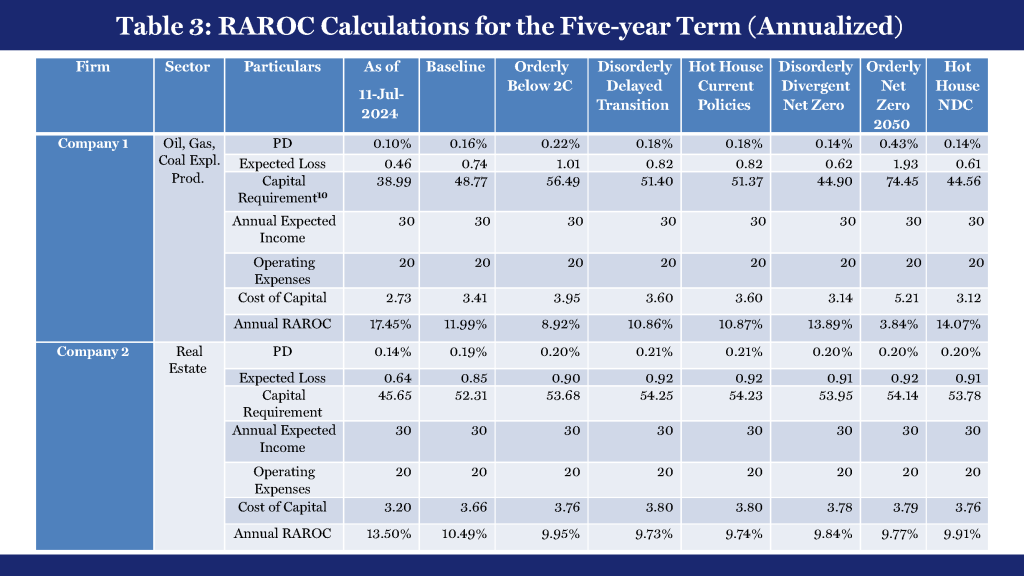
Company 1 is sensitive to the Orderly Net Zero 2050 and Below 2°C scenarios, with a significant increase in PDs and a decline in annualized risk-adjusted returns on capital (RAROCs). Company 1’s PDs and RAROCs are more volatile across scenarios. Company 2’s PDs do increase from the baseline scenario, but relative changes across scenarios are much smaller than for Company 1, and this is reflected in the RAROC as well. Overall, Company 2 seems to be more resilient to climate-scenario changes, showing less variation in both PD and RAROC across scenarios.
This stylized example illustrates that the integration of climate risks into risk-based pricing models is not merely prudent but essential to maintaining a healthy portfolio and aligning with regulatory and market expectations. This approach also enables a more holistic view of risk and return, preventing mispricing and supporting appropriate reshaping of portfolios.
Further, climate-adjusted pricing outcomes are scenario-based, while a loan is granted at a specific price. Emerging approaches tend towards using an average PD across scenarios or a scenario weighted-average PD. This weighted climate-conditioned PD can serve as input to both the ECL and RWA underlying risk-based pricing models.
Moreover, climate risks tend to manifest and intensify over longer periods. Post-IFRS 9, most models tend to estimate RAROC across the lifetime of the instrument, and typical outputs include the following:
- Lifetime cumulative RAROC at maturity,
- Cumulative RAROC at yearly intervals to maturity,
- Annualized RAROC to maturity.
Substituting climate PDs in the ECL and RWA components of a lifetime RAROC model would be relatively easy.
Lastly, banks may also gain strategic advantages from climate-adjusted risk-based pricing. By analyzing climate-related risks and opportunities across their portfolios, banks can develop nuanced understandings of how various sectors and individual borrowers may be hurt or benefit from the transition to a low-carbon economy. This will help banks more accurately reflect the true risk-return profiles of their loans while identifying and capitalizing on emerging opportunities in sustainable finance, green technologies and climate-resilient sectors, potentially opening new revenue streams and strengthening their competitive positions in an increasingly climate-conscious financial landscape.
Disclaimer: The views contained in this paper are solely those of the author and may not reflect the views of Moody’s Analytics.
References
1 World Bank/Open Knowledge Repository (OKR): “State and Trends of Carbon Pricing 2023.”
2 Bank for International Settlements (BIS): “Pricing of climate risks in financial markets: a summary of the literature,” Egemen Eren, Floortje Merten and Niek Verhoeven, December 9, 2022, BIS Paper Number 130.
3 Bank for International Settlements (BIS): “An Explanatory Note on the Basel II IRB Risk Weight Functions,” BCBS, July 5, 2005.
4 Moody’s: “Quantifying the impact of climate on corporate credit risk,” April 1, 2023.
5 Network for Greening the Financial System (NGFS): “NGFS Climate Scenarios for central banks and supervisors – Phase IV,” July 11, 2023, NGFS Publications.
See also:
Bloomberg: “HSBC Tells Clients It Won’t Blacklist Major Polluters,” Alastair Marsh, January 26, 2024.
and
Reuters: “JPMorgan, State Street quit climate group, BlackRock steps back,” Simon Jessop and Ross Kerber, February 15, 2024.