

 By Dr. Ivailo Izvorski, Chief Economist Europe and Central Asia Region, World Bank Group
As governments around the world sprang into industrial action amid the COVID-19 pandemic and subsequent crises, so did governments in Europe and Central Asia (ECA). Slowing productivity growth also prompted them to look beyond the broad structural reforms that had been the main driving force of the three-decade transition from planned to market economies. Industrial policy, targeting specific sectors, activities or enterprises, has surged as a result, and a new World Bank report examines whether it is helping reverse the productivity slowdown in many countries in the region. So far, it is not. The reasons are myriad and not the most obvious ones.
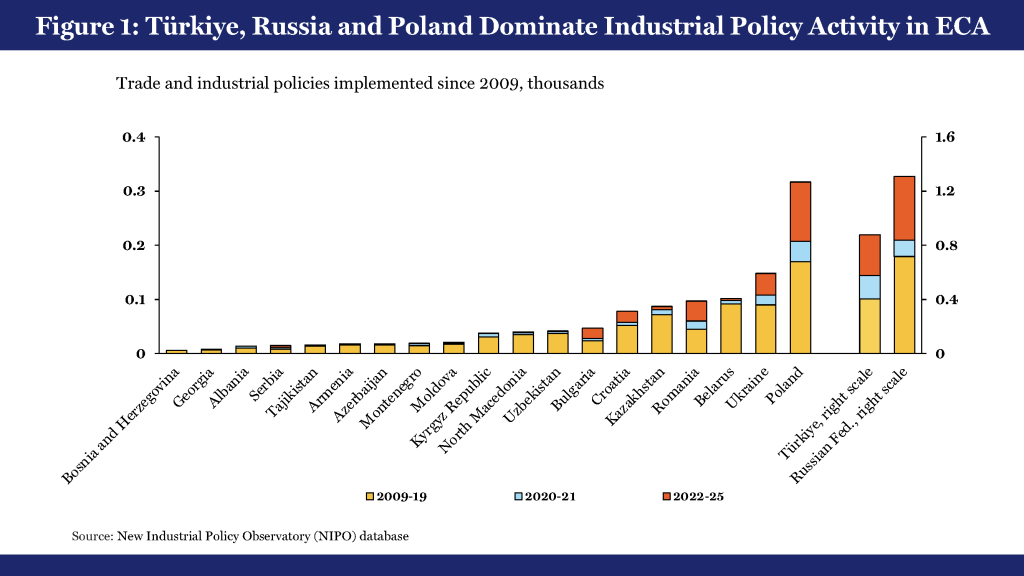
The use of industrial policies in ECA accelerated after the 2008 Global Financial Crisis (GFC) and then surged after 2020. The boost after 2020 was driven by COVID pandemic relief, but the focus has since shifted to energy efficiency, supply-chain resilience and national security. The number of annual policy announcements now exceeds pre-pandemic levels in a third of the 23 ECA countries, led by Russia, Türkiye and Poland (Figure 1). Russia and Türkiye alone account for three-fourths of all interventions in the region.
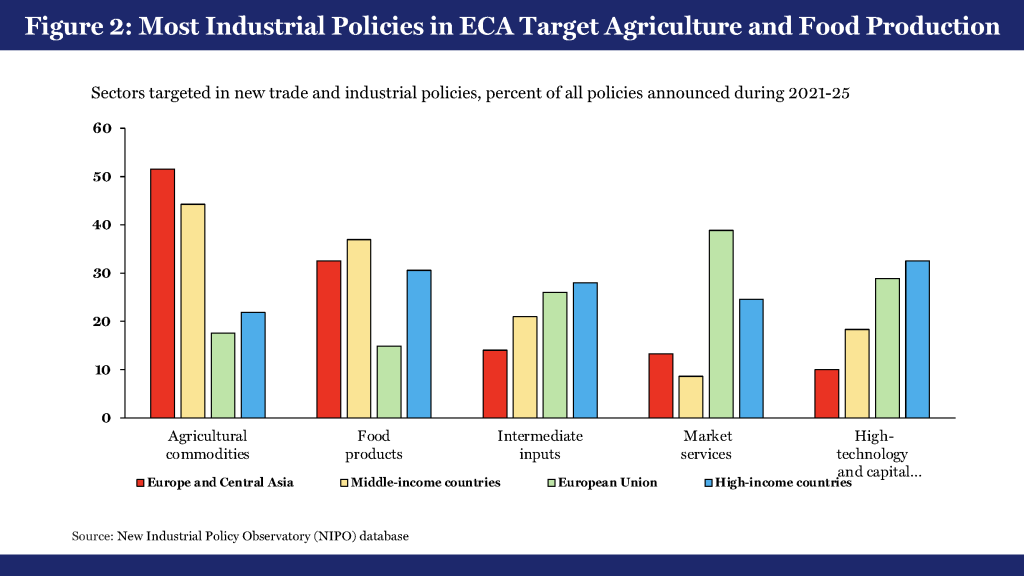
Somewhat surprisingly for a solidly middle-income region with a higher gross domestic product (GDP) per capita than either Latin America and the Caribbean (LAC) or East Asia and the Pacific (EAP), most of these policies target agriculture, food production and intermediate goods (Figure 2). Only 10 percent are aimed at high-tech or capital goods. There are very few attempts at moonshots, and limited evidence that even those are properly funded or targeted. High-income countries and China, by contrast, increasingly focus their industrial policies on advanced manufacturing, semiconductors and digital infrastructure. ECA is not betting on the future; it is subsidizing the past.
Industrial policies fall into three broad groups.
Industrial policies fall into three broad groups. The first is tailored public inputs: special economic zones (SEZs), export-promotion agencies, skills-development programs and sectoral roundtables. These address coordination failures and information gaps with relatively low risk of market distortion or retaliation from trading partners, which is why the report treats them as first-choice instruments. The second is market interventions: domestic subsidies, import and export tariffs, export bans, local-content requirements and public-procurement rules that alter relative prices to steer investments toward preferred activities. Subsidies are the least distortionary of these and demand fiscal space; tariffs and bans are what governments reach for when they lack it. The third is macroeconomic interventions, such as currency devaluations, R&D (research and development) tax credits and broad-based tax incentives. Unlike firm- or sector-specific measures, these have economy-wide reach.
Each instrument targets a specific failure, and each fails in a specific way. Special economic zones bundle infrastructure, streamlined customs procedures and tax holidays to attract foreign investment without overhauling the broader regulatory environment. Shenzhen turned a fishing village into a technology hub, and Türkiye’s Organized Industrial Zones (OIZs) have drawn substantial foreign direct investment (FDI). But the benefits often stay inside the fence. A recent study of Kazakhstan found that neither its SEZs nor its industrial zones generated the local jobs they promised, nor did either produce enough fiscal revenue to cover the cost of its own infrastructure. Export- and investment-promotion agencies exist because domestic firms cannot easily gather information about foreign buyers; 120 countries have at least one, and evidence suggests they can meaningfully increase export diversification. But effectiveness swings wildly with the agency’s mandate, budget and institutional quality. Skills programs address a genuine market failure—firms underinvest in training because trained workers may be poached—and sectoral roundtables, such as Ireland’s National Competitiveness Council (NCC), force the government and the business community to name specific bottlenecks and divide responsibility for fixing them. These are the cheapest interventions available and the ones most consistently worth making.
The money and the danger lie in market interventions. Production and innovation subsidies can support learning-by-doing and technology adoption, but they distort competition and require fiscal space to sustain them. Tariffs, quotas and export bans are second-choice tools precisely because they work by making things more expensive: They shield infant industries and, far more often, entrenched incumbents, imposing the costs on domestic consumers.
In ECA, subsidies have become the dominant tool, and their use has grown dramatically. After being among the lowest in the world, subsidy levels in the region are now the highest among developing regions. Import tariffs are rarely used, but non-tariff import measures and export bans are common. In ECA excluding Russia, 60 percent of export measures introduced since 2020 are outright bans; in Russia, nearly 80 percent are export taxes, most of them on grain. Local-content requirements and technology-transfer mandates promise to build domestic capacity but also raise costs, distort trade and invite World Trade Organization (WTO) challenges. They also need a large market to work at all, which is why most ECA countries cannot succeed.
Macroeconomic tools carry their own traps. Devaluation has not been used as an industrial policy in ECA, and rightly so: A weaker currency raises the costs of the imported inputs that feed into exports, erodes real wages and inflates foreign-currency debt. R&D tax credits demonstrably increase R&D spending, but there is no evidence they increase patenting or the quality of patents. And when incumbents capture credits to defend market share rather than innovate, the effect on aggregate productivity can be close to nil. As for tax holidays, they cannot compensate for poor governance, weak contract enforcement, unreliable utilities or an unskilled workforce. Where the fundamentals are bad, they simply do not work. They just cost money.
The evidence on whether industrial policy delivers structural transformation or productivity growth is mixed at best. Against the few successes, economic history is full of large fiscal burdens, costly failures and negative spillovers to other sectors. In some cases, subsidies and price rigidities undermine the very signals on which markets depend.
A case study from North Macedonia shows the limits of well-intentioned programs. An impact evaluation of innovation programs run by the Fund for Innovations and Technology Development (FITD) found that supported firms did expand employment, wages, investments and sales. But productivity did not improve. Fewer than 5 percent of low-productivity firms moved up; more than 60 percent ended up in exactly the same productivity segment they started in; and more than 30 percent reported declining productivity after receiving aid. The programs generated activity, but not transformation.
Three factors explain most industrial-policy failures. The first is political capture: When implementing agencies lack independence, well-connected interest groups secure subsidies and protection rather than fostering genuine innovation. The second is information gaps and misaligned incentives: Government officials rarely possess the real-time knowledge that private actors do, and they do not bear the costs of failure. The third is flawed benchmarking. Many governments have tried to replicate the growth of postwar Japan or 1970s Singapore by focusing on state direction while overlooking the high savings and investment rates, strong education systems, vibrant business environments and strong labor productivity that were the main drivers behind those successes.
For ECA countries, structural reforms remain the foundation for economic vibrancy.
For ECA countries, structural reforms remain the foundation for economic vibrancy. Modernizing the business environment, reducing the footprints of state-owned enterprises, encouraging entrepreneurship and improving education are all prerequisites for sustained productivity growth. Where clear market failures exist, tailored public inputs—such as special economic zones and skills-development programs—can help address them without distorting competition. Tools such as production subsidies and trade measures require a higher bar: strong justification, sufficient government capacity to design and monitor programs, clear sunset provisions and transparent reporting of costs and outcomes.
The right approach also depends on what stage a country sits in its development. For ECA’s middle-income countries aiming for high-income status, policies that support better education, skills development and the infusion of foreign ideas and technology are the preferred approach. It is often the underprovision of basic government services (such as a poor business environment or a weak education system) that leads to calls for industrial policy in the first place. Governments should consider addressing lagging productivity and limited business dynamism through broader reforms rather than narrowly targeted interventions.
The bottom line is that industrial policies can address specific market failures, but they are no substitute for structural reform. Contestable markets, open to trade and investment, are the essential foundation. Without strong institutions, real domestic competition and genuine government capacity, the risks of capture, waste and distortion are simply too high.
Dr. Ivailo V. Izvorski is the Chief Economist for the World Bank’s Europe and Central Asia Region. With nearly 30 years of experience, he has held senior technical and managerial roles at the World Bank, the Institute of International Finance (IIF) and the International Monetary Fund (IMF), including leading the World Bank’s Global Debt, Macro and Growth Unit. He holds a Ph.D. from Yale University.