





By Dr. Simon Cottrell, Finance Lecturer and the Research Degree Coordinator for Finance and Property; Md Farhan Imtiaz, PhD Scholar and Lecturer; Prof. Chandrasekhar Krishnamurti, Professor of Finance, UniSA Business; and Dr. Hao Zhou, Finance Lecturer, University of South Australia’s Business School
Geopolitical tensions have become an increasingly influential factor in the global financial landscape, significantly impacting the stability and risk profiles of banks. The 2023 “Global Financial Stability Report” by the International Monetary Fund (IMF) highlighted the significant escalation of geopolitical tensions, notably due to deteriorating US-China relations and Russia’s invasion of Ukraine. These tensions have particularly impacted cross-border investment portfolios and bank credit allocation, with a 15-percent decrease in bilateral cross-border allocation of portfolio investments and bank claims between the United States and China.
Geopolitical shocks pose substantial financial-stability risks for the global banking sector. They can trigger a sudden reversal of cross-border credit and investments, leading to financial fragmentation, increased debt-rollover risks and higher funding costs for banks, particularly those that rely heavily on wholesale funding. Additionally, heightened uncertainty can widen sovereign bond and credit spreads, reducing the value of banks’ assets and increasing their funding costs (International Monetary Fund, 2023)1. Overall, the increased financial fragmentation due to geopolitical tensions poses substantial risks to financial stability, which can increase default risks for banks. Given the profound impacts of geopolitical risk on the global banking sector, this article examines how geopolitical risks affect the default risks of global systemically important banks (G-SIBs) compared to non-G-SIBs of similar size and importance, using credit default swap (CDS) spreads as the primary measure of default risk.
CDS serves as a crucial indicator of default risk, offering insights into the creditworthiness of banks. CDS spreads represent the cost of insuring against potential losses from a bank’s default. As geopolitical risks escalate, banks with exposures to affected regions face increased credit risks, leading to higher CDS spreads. This phenomenon underscores the importance of understanding how geopolitical tensions influence the default risks of both G-SIBs and non-G-SIBs.
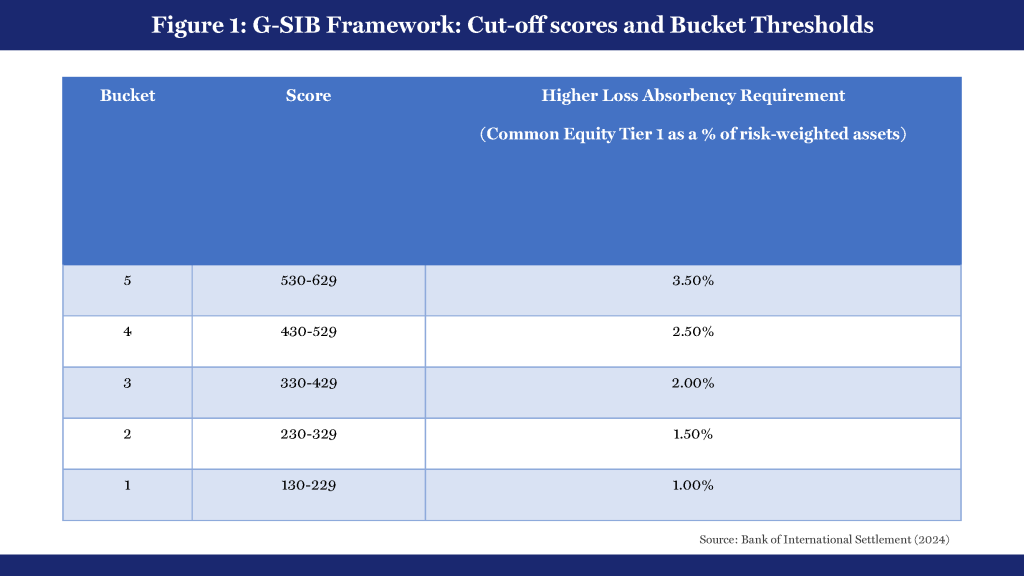
To classify a G-SIB, the Bank for International Settlements (BIS) uses indicators collected by national supervisory authorities from a sample of banks. G-SIB status is based on five criteria: cross-jurisdictional activity, interconnectedness, size, substitutability and complexity. These indicators are equally weighted to calculate each bank’s score. A score of 130 basis points or higher qualifies a bank as a G-SIB. Banks with higher scores fall into higher buckets, which have higher loss-absorbency capital requirements. The list of G-SIBs is reviewed annually, allowing banks to move in or out of the classification or be reclassified at different levels of systemic importance. Figure 1 shows the additional capital requirements for the different G-SIB buckets.
Using a unique dataset of monthly CDS data for 46 banks across 10 countries from January 2012 to November 2023, our study examines the differential impact of geopolitical risk on the CDS spreads of G-SIBs and non-G-SIBs. Our sample includes banks designated as G-SIBs by the Financial Stability Board (FSB) as of November 27, 2023, and a comparable group of large banks not considered systemically important globally (non-G-SIBs). We focus on five-year senior CDS instruments, which are the most liquid contracts and constitute 85 percent of the entire CDS market. Our study aims to understand how changes in geopolitical risks affect the perceived riskiness of banks and whether geopolitical risks impact the default risks of G-SIBs differently than non-G-SIBs.
To quantify geopolitical risk, we use the Geopolitical Risk Index (GPR Index) developed by Caldara and Iacoviello (2022)2. This index measures geopolitical uncertainty by tracking the percentage of monthly news articles mentioning adverse geopolitical events and related threats. It shows notable spikes during key historical events, such as the onset of both world wars, the Korean War, the Cuban Missile Crisis and the aftermath of the September 11, 2001, attacks. The Benchmark Index (GPR) uses data from 10 newspapers starting in 1985. It relies on automated text searches across 10 prominent newspapers: Chicago Tribune, The Daily Telegraph, Financial Times, The Globe and Mail, The Guardian, Los Angeles Times, The New York Times, USA Today, The Wall Street Journal and The Washington Post. Each month, the index counts the number of articles addressing escalating geopolitical risks and divides this figure by the total number of published articles for the same period. Figure 2 illustrates the monthly GPR Index from 1985 to 2020, highlighting the events that caused spikes in the timeline.

Prior literature suggests that geopolitical risks, such as the 2016 US presidential election, increase bank CDS spreads, indicating higher default insurance costs (Hachenberg et al., 2017)3. Geopolitical risk elevates sovereign risk, leading to higher sovereign and corporate CDS spreads, demonstrating a spillover effect (Bedendo & Colla, 2015)4. Sovereign credit risk is closely linked with bank CDS spreads, especially during crises, providing insights into banks’ default probabilities (Avino & Cotter, 2014)5. High geopolitical risk can negatively impact investor sentiment and bank stability (Shleifer & Vishny, 2010)6. Thus, we hypothesize that geopolitical risk is positively associated with the CDS spreads of large global banks.
However, the effects of geopolitical risk on G-SIBs may differ from its effects on similarly sized banks not deemed G-SIBs by the FSB (non-G-SIBs). One perspective is that G-SIBs face greater default risks due to their size, complexity and global reach. G-SIBs are more exposed to geopolitical risks because of their extensive international operations (Violon et al., 2017)7 and significant cross-border activities, making them susceptible to defaults in tense regions (Moratis & Sakellaris, 2021)8. In contrast, non-G-SIBs have simpler, more localized operations and fewer international exposures. Another perspective is that geopolitical risk may lower CDS spreads for G-SIBs compared to non-G-SIBs. G-SIBs often have tighter CDS spreads due to their “too-big-to-fail” (TBTF) status, with investors expecting government support during crises, reducing their perceived risks (Araten & Turner, 2013)9. This TBTF perception gives G-SIBs an advantage in funding costs. Stricter capital requirements also reduce default risk (Couaillier & Henricot, 2023)10. Since non-G-SIBs lack this implicit support and are not required to hold additional capital, geopolitical risks could result in lower CDS spreads for G-SIBs compared to non-G-SIBs. Given these differing views, we examine whether G-SIB status significantly influences banks’ CDS spreads in the context of geopolitical risk.
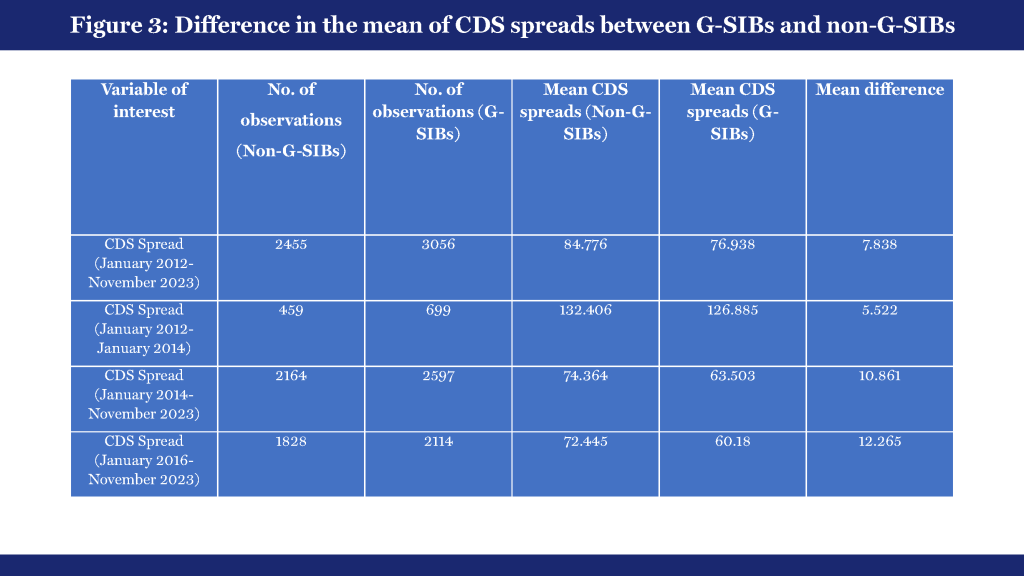
A noticeable difference in the average CDS spreads between G-SIBs and non-G-SIBs may indicate divergent market perceptions of risk and the potential benefits that G-SIBs enjoy by virtue of their systemic importance. Figure 3 shows the monthly average CDS spreads spanning from January 2012 to November 2023. G-SIBs exhibit lower CDS spreads in comparison to non-G-SIBs throughout the period of the analysis. Despite a brief interval from January 2012 to January 2014 when non-G-SIBs seemed to exhibit lower CDS spreads, data covering 2014 to 2023 consistently indicate that G-SIBs have lower CDS spreads.
A comparison of CDS spreads between G-SIBs and non-G-SIBs is presented in Figure 3. Over the 12-year period, G-SIBs had an average CDS spread of 76.94 basis points, compared to 84.78 basis points for non-G-SIBs, resulting in a 7.84 basis-point lower spread for G-SIBs. Notably, the only interval during which non-G-SIBs displayed lower CDS spreads was between January 2012 and January 2014, with an average of 4.92 basis points less. Nevertheless, during the periods from January 2014 to November 2023 (Row 3) and from January 2016 to November 2023 (Row 4), non-G-SIBs consistently exhibited higher CDS spreads, with the disparity continuously increasing over time.
To further investigate the impacts of geopolitical risk on the CDS spreads of both G-SIBs and non-G-SIBs, we conducted a cross-sectional statistical analysis utilizing ordinary least squares regressions. Our analysis suggests that geopolitical risks have notable effects on the default risks of financial institutions, with varying consequences for G-SIBs and non-G-SIBs. Geopolitical risk exhibits a negative correlation with CDS spreads for G-SIBs, indicating that rising geopolitical tensions lead to decreases in the cost of default protection for these institutions. This relationship is statistically significant at a confidence level of 1 percent. Conversely, the analysis of non-G-SIBs indicates that a rise in geopolitical risk triggers an increase in default risk, as evidenced by a significantly positive coefficient for geopolitical risk. Our results suggest that G-SIB status reduces CDS spreads by 14.4 percent to 16.2 percent compared to non-G-SIBs during periods of heightened geopolitical risk. This underscores the market’s perception of G-SIBs as “too big to fail” (TBTF), suggesting an implicit government assurance that reduces their perceived default risks. This implicit government assurance for G-SIBs plays a critical function in diminishing their default risks amid geopolitical upheavals. This assurance is grounded in the TBTF principle, which posits that the collapse of a G-SIB would have severe repercussions for the worldwide financial system. Consequently, governments are expected to step in to prevent such collapses, either through direct bailouts or other types of support, such as emergency liquidity facilities. This expectation of government intervention lowers the perceived risk of default for G-SIBs, leading to narrower CDS spreads. However, this implicit also fosters moral hazard, as G-SIBs may engage in riskier financial practices, knowing they are likely to receive government support in the event they need it.
To establish a causal relationship between geopolitical risk and CDS spreads, we utilized a difference-in-difference (DiD) approach focusing on two notable geopolitical incidents: the annexation of Crimea by Russia in 2014 and the terrorist attacks in Paris in 2015. These events are considered external shocks to geopolitical risk, enabling us to assess their influence on the CDS spreads of both G-SIBs and non-G-SIBs. The analysis confirms that G-SIBs exhibit lower CDS spreads in comparison to non-G-SIBs subsequent to these geopolitical shocks. Our results suggest that G-SIBs avail themselves of implicit government safety nets that diminish their perceived risks of default during times of geopolitical turmoil.
To ensure the robustness of our findings, we conducted additional tests using alternative measures of default risk, such as the 1-year and 5-year Probability of Default (PD) metrics from the Credit Research Initiative (CRI) developed at the National University of Singapore (NUS). These metrics corroborate our main findings, showing that geopolitical risks increase the default risks of non-G-SIBs while reducing the default risks of G-SIBs.
The findings from this research hold significant implications for policymakers. The differential impacts of geopolitical risk on G-SIBs and non-G-SIBs underscore the necessity for policymakers to tackle the moral hazard associated with the TBTF principle. It is essential to implement enhanced regulatory actions and risk-management strategies to alleviate the systemic risks emanating from G-SIBs, thus safeguarding financial stability amidst geopolitical instabilities. Moreover, the diverse impacts of geopolitical risk on G-SIBs in comparison to non-G-SIBs present a probable systemic-risk element from a policy viewpoint.
A potential issue arises if policymakers are lulled into a false sense of security when CDS spreads for G-SIBs decline amid rising geopolitical risk. This complacency could lead to delayed intervention, reminiscent of the government’s slow response to the Lehman Brothers collapse during the 2008 Global Financial Crisis (GFC). Our study thus urges caution in using CDS spreads as the sole indicator of default risk. While G-SIBs may appear to have lower default risks during geopolitical upheavals due to perceived government support, this also raises concerns about moral hazard. In contrast, non-G-SIBs, lacking such implicit assurances, face heightened default risks during these periods. Policymakers must navigate the fine line between ensuring stability and mitigating moral hazard by ensuring that G-SIBs and similarly sized banks not classified as G-SIBs have robust risk-management frameworks in place.
References
1 International Monetary Fund (IMF): “Global Financial Stability Report: Safeguarding Financial Stability amid High Inflation and Geopolitical Risks,” April 11, 2023.
2 American Economic Review: “Measuring Geopolitical Risk,” Dario Caldara and Matteo Iacoviello, April 2022, Volume 112, Number 4, Pages 1194-1225.
3 Finance Research Letters: “The impact of expected regulatory changes: The case of banks following the 2016 U.S. election,” Britta Hachenberg, Florian Kiesel, Sascha Kolaric and Dirk Schiereck, August 2017, Volume 22, Pages 268-273.
4 Journal of Corporate Finance: “Sovereign and corporate credit risk: Evidence from the Eurozone,” Mascia Bedendo and Paolo Colla, August 2015, Volume 33, Pages 34-52.
5 Journal of International Financial Markets, Institutions and Money: “Sovereign and bank CDS spreads: Two sides of the same coin?” Davide Avino and John Cotter, September 2014, Volume 32, Pages 72-85.
6 Journal of Financial Economics: “Unstable banking,” Andrei Shleifer and Robert W. Vishny, September 2010, Volume 97, Issue 3,Pages 306-318.
7 Bank of France: “The impact of the identification of GSIBs on their business model,” Aurélien Violon, Dominique Durant and Oana Toader, December 19, 2017, Débats économiques et financiers (33).
8 Journal of Financial Stability: “Measuring the systemic importance of banks,” Georgios Moratis and Plutarchos Sakellaris, June 2021, Volume 54, 100878.
9 Journal of Risk Management in Financial Institutions: “Understanding the funding cost differences between global systemically important banks (GSIBs) and non-G-SIBs in the USA,” Michel Araten and Christopher Turner, 2013, Volume 6, Issue 4, Pages 387-410.
10 Journal of Banking & Finance: “How do markets react to tighter bank capital requirements?” Cyril Couaillier and Dorian Henricot, June 2023, Volume 151, 106832.
Md Farhan Imtiaz is a PhD scholar, a casual Lecturer at University of South Australia’s Business School and an Assistant Professor at University of Dhaka, Bangladesh. Imtiaz has research interests in Banking, Financial Technology, Corporate Finance, and Market Microstructure.
Prof. Chandrasekhar Krishnamurti is a Professor in Finance at UniSA Business, University of South Australia, Australia. Chandra has research interests in banking, corporate finance, corporate social responsibility, and market microstructure and has published widely in leading academic journals, such as Journal of Corporate Finance, Journal of Banking and Finance, Pacific-Basin Finance Journal etc.
Dr. Hao Zhou is a Lecture of Finance. Hao’s main research interests include algorithmic trading, cryptocurrencies, and market microstructure. He has examined algorithmic execution strategy and the role of computerized traders during turbulent periods of financial markets. Hao teaches undergraduate and postgraduate courses in finance and data analytics, including financial risk analysis, financial markets, behaviour finance and machine learning.