
By Alexander Jones, International Banker
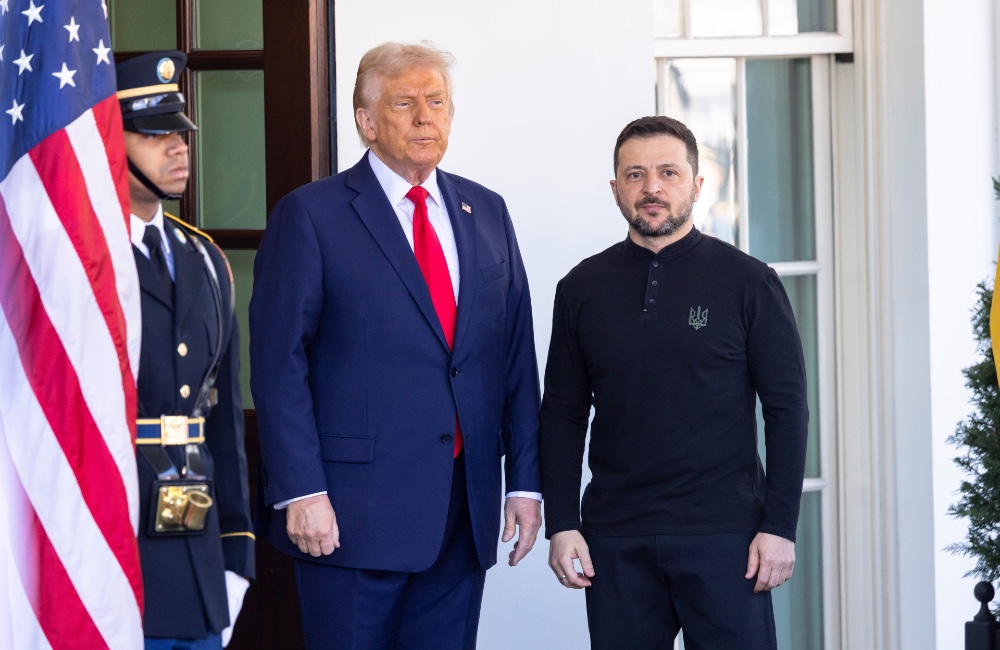
“Before I even arrive at the Oval Office, shortly after we all together win the presidency, we will have the horrible war between Russia and Ukraine settled. It will be settled,” Donald Trump promised at an election campaign rally in August 2023. “The war is going to be settled. I’ll get them both—I know Zelenskyy, I know Putin; it’ll be done within 24 hours, you watch. They all say, ‘That’s such a boast.’ It will be done very quickly.” Fast forward nearly two years, and that pledge has fallen flat on its face. And with a diverging position on this conflict emerging between the United States and Europe, serious economic ramifications could surface as the war rumbles on into its fourth year.
Since becoming the US president, Trump has claimed that those audacious pledges—which were uttered frequently on the campaign trail—were not to be taken literally. “Well, I said that figuratively, and I said that as an exaggeration, because to make a point, and you know, it gets, of course, by the fake news,” he told Time magazine in an interview published on April 25. “Obviously, people know that when I said that, it was said in jest, but it was also said that it will be ended.” Such attempts to put a brave face on the situation notwithstanding, however, bringing the war to a decisive close continues to prove an elusive task for the president.
Indeed, the scale of the task can be no more clearly exemplified than by the abject failure of the much-hyped peace talks in Istanbul, Turkey, on May 16 involving delegates from both combatant nations—the first time they had met face-to-face since March 2022, roughly one month after the start of the war. But the latest talks broke down, with reports noting that discussions lasted less than two hours in total. “Ukraine is ready to take the fastest possible steps to bring real peace, and it is important that the world holds a strong stance,” Ukrainian President Volodymyr Zelenskyy posted on X soon after the talks ended, adding that “tough sanctions” were required for Russia should it reject a full and unconditional ceasefire.
As for Russia, which continues to make incremental gains on the battlefield, concerns abound in Moscow that a temporary ceasefire will allow Ukraine to regroup and rearm its military forces. “We have agreed that each side will present its vision of a possible future ceasefire and spell it out in detail,” Russia’s lead negotiator, Vladimir Medinsky, told reporters after the meeting. “After such a vision has been presented, we believe it would be appropriate, as also agreed, to continue our negotiations.”
A two-hour phone conversation was then held on May 19 between Trump and Russian President Vladimir Putin, but it again fell short of making concrete progress towards bringing the 39-month war to a close, with the Russian president rejecting a proposal from Washington with the backing of Kyiv to sign on to a 30-day ceasefire. And with evidence now growing that Trump may look to retreat from the discussions and let Moscow and Kyiv continue to engage in direct talks instead, the divide between the approaches to the conflict taken by the US on the one hand and the European Union (EU) and United Kingdom (UK) on the other is set to widen further. “I think something’s going to happen,” Trump told reporters following the call. “And if it doesn’t, I just back away, and they’re going to have to keep going.”
While Trump may back off, the EU and UK appear intent on intensifying their support for Ukraine and attempting to ratchet up the pressure on Moscow, with reports suggesting that Ukraine’s European allies regard a continuation of the conflict as crucial for the continent’s security. But a significant withdrawal of US military aid to Ukraine could create serious difficulties for Europe, according to the Associated Press (AP), which spoke to unnamed analysts and diplomats in late April.
Kyiv’s ability to keep fighting would then depend on the extent to which European political will could muster more money and weapons, the AP report added, and how quickly the gaps left by Washington could be filled. If it were easy, Europe would “already be doing things without America”, a European diplomat, speaking on condition of anonymity, also told the AP.
Since Trump came back into power, the US has not approved a single aid package for Ukraine, despite European nations having collectively provided Ukraine with more aid than Washington, according to the Kiel Institute for the World Economy. Europe has contributed around $157 billion, the German economic research institute and think tank recently noted, which is $26 billion more than the US. That said, Washington is marginally ahead of Europe when it comes to military aid.
Should the US initiate a major withdrawal from this particular war theatre, however, some believe that Europe could at least partially offset the shortfall. “In addition to providing aid, European states have trained more Ukrainian troops than the United States, totalling over 70,000 individuals,” according to an analysis from the Center for Strategic and International Studies (CSIS), published on May 19. “Although Europe’s collective economic strength dwarfs that of Russia, Europe is not on a war footing, while Russia is. Expanding production for artillery, ammunition, and other essentials is possible, but such an expansion would be time-consuming. Despite more than three years of war in Ukraine, Europe has made only limited progress.”
That said, both the EU and the UK continue to ramp up punitive economic measures against Moscow, with sanctions being implemented in the days before the Istanbul talks, despite the US not following suit. With Russia commemorating the 80th anniversary of Victory Day on May 9, for instance, the UK chose the same day to sanction up to 100 oil tankers that form a core part of Moscow’s shadow-fleet operation, before the EU, five days later, unleashed its 17th package of sanctions against Russia. Both parties then announced additional sanctions on May 20, again without the United States and also targeting Moscow’s shadow fleet of oil tankers, as well as various financial companies.
“At well over 20,000 sanctions imposed so far, Russia’s economy has proved remarkably robust, and its key export sectors still find ways to deliver similar volumes across the world. At some point, I hope policymakers in London, Brussels and Washington will start to ask whether this policy is working,” Ian Proud, a former senior UK diplomat at the British Embassy in Moscow from 2014 to 2019, recently wrote in a Substack post.
“Moreover, dragging out the war for longer would simply add to Europe’s contingent liability to fund Ukraine’s war effort at a time when it is only ever going to lose,” Proud further contended. “Ukraine is spending over 26 percent of [its] GDP on defence in 2025, and 67.5 percent of its budget expenditure is on defence and security, leaving a budget black hole of $42 billion that has to be filled. America under Trump isn’t going to fill this hole. And, as Ukraine is cut off from international lending markets, that black hole is being filled by Europe.”
Nonetheless, the US continues to pursue specific economic interests in the region, such that a complete withdrawal of American involvement seems unlikely. On April 18, Kyiv and Washington signed a memorandum of intent (MOI) as a precursor towards a more comprehensive economic deal that will likely involve the reconstruction of Ukraine’s war-torn country and economy. It will also detail the nature of US involvement in developing Ukraine’s vast areas of critical minerals, such as lithium, titanium and a whole host of rare-earth metals, in what Trump sees as repayment for the tens of billions of dollars in support the US has provided since the war with Russia began in February 2022.
One also must not completely discount the possibility of tensions between Russia and Ukraine easing before too long. “We have agreed with the president of the United States that Russia will propose and is ready to work with the Ukrainian side on a memorandum on a possible future peace accord, defining a number of positions, such as, for example, the principles of settlement, [and] the timing of a possible peace agreement,” Putin told reporters following the May 19 call, noting that direct talks between Russia and Ukraine “give reason to believe that we are generally on the right track”.
If appropriate agreements are reached, then a ceasefire could be attainable, Putin added. “I would like to note that, on the whole, Russia’s position is clear. The main thing for us is to eliminate the root causes of this crisis,” the Russian president confirmed. “We just need to determine the most effective ways to move towards peace.”