

Saudi Arabia’s largest banks, including Saudi National Bank (SNB), Alrajhi Bank and Riyad Bank, recorded stronger earnings in the first half of 2026, supported by solid lending growth, resilient operating income and improved liquidity, according to stock-exchange filings. Lenders have continued to benefit from strong demand for credit as the Kingdom’s diversification programme drives financing across housing, infrastructure, tourism and corporate investment.
Saudi National Bank, the Kingdom’s largest lender, reported a net profit of SR 13.02 billion (US$3.47 billion) for the first six months of the year, an increase of 7.15 percent from the same period in 2025, while Alrajhi Bank generated the highest first-half profit among Saudi lenders, with earnings rising 14.15 percent year-on-year to SR 13.76 billion. Riyad Bank posted a net income of SR 5.26 billion, up 3.54 percent. Alinma Bank also delivered a strong performance, with its first-half net profit increasing by 6.24 percent to SR 3.27 billion.
Saudi Central Bank (SAMA) data showed that total bank lending to the private sector reached a record SR 3.2 trillion in May, representing an annual growth of 16.2 percent. The figure highlights the continued expansion in financing activity that has supported bank earnings. Tony Hallside, chief executive of STP Partners, said Saudi banks’ profitability increasingly reflected more than movements in interest rates, as reported by Arab News. Hallside added that the sector’s strong results were supported by robust credit demand, particularly from Vision 2030-related projects, as well as better liquidity, disciplined risk management and continued spending on digital capabilities.
According to the Central Bank of the United Arab Emirates (CBUAE), the total assets of banks operating in the UAE increased by 4.1 percent quarter-on-quarter (Q/Q) in the first quarter (Q1) of 2026, reaching AED 5,556.5 billion (US$1,500 billion). Between March 2025 and March 2026, the aggregate assets of banks operating in the UAE rose by 17.7 percent year-on-year (Y/Y). Gross credit increased by 4.9 percent quarter-on-quarter, reaching AED 2,695.6 billion at the end of March 2026 and recording an annual increase of 20.3 percent.
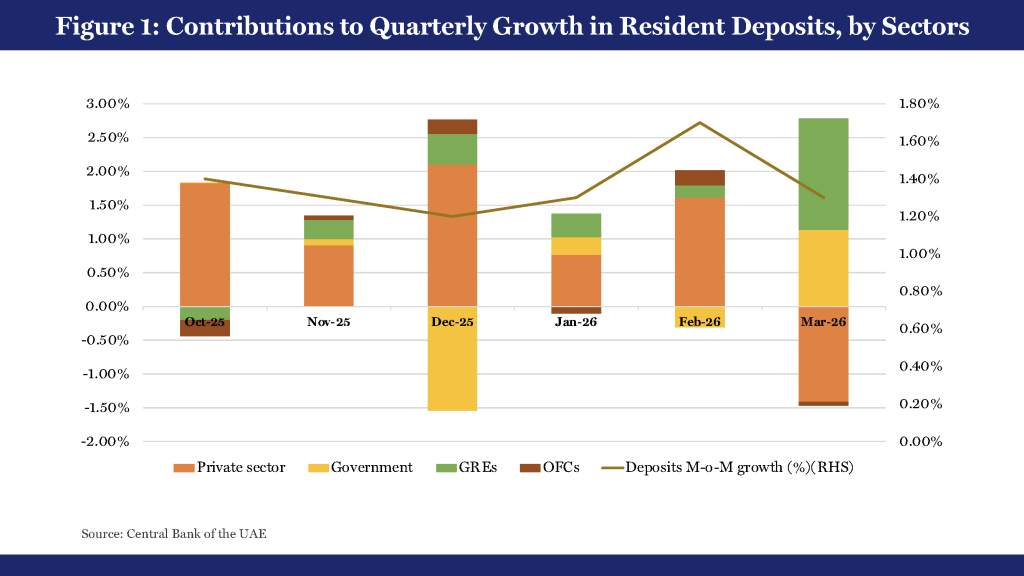
The central bank also noted that total resident and non-resident deposits with banks operating in the UAE increased by 4.3 percent Q/Q and 17.4 percent Y/Y, reaching AED 3,446.0 billion in Q1 2026. Resident deposits increased by 4.4 percent Q/Q to hit AED 3,138.8 billion, while non-resident deposits rose by 3.1 percent Q/Q, reaching AED 307.2 billion by the end of March 2026. The GREs (Government Related Entities) Sector accounted for the largest contribution to quarterly resident-deposit growth, contributing 2.2 percentage points, followed by the Government and Private Sector contributing 1.1 percentage points and 0.9 percentage points, respectively. On a year-on-year basis, resident deposits increased by 16.8 percent, and non-resident deposits rose by 23.5 percent.
The aggregate capital and reserves of banks operating in the UAE decreased by 1.8 percent Q/Q, settling at AED 586.9 billion at the end of Q1 2026. The capital adequacy ratio (CAR) declined to 16.8 percent, remaining well above the minimum requirement of 13.0 percent, including the 2.5 percent capital conservation buffer and the 15.7 percent Tier 1 capital ratio requirements, in compliance with the Basel III guidelines.
Oman’s banking industry is expected to remain resilient despite the continuing conflict involving Iran, supported by favourable economic conditions, strong capital positions and stable sources of funding, according to a new Fitch Ratings peer review of the country’s banking sector. The credit-rating agency also stated that the effect of the Iran war on Omani banks’ operating environment is likely to remain relatively limited in 2026 and described Oman as the Gulf country least exposed to the conflict because its exports do not rely on passage through the Strait of Hormuz.
Fitch also stated that higher oil prices, together with the government’s diversification agenda under Oman Vision 2040, continued to support economic activity and created new opportunities for lenders. It forecast bank lending to grow by around 5 percent this year, only slightly below its earlier forecast of 6 percent to 7 percent. Credit expansion will be supported by corporate borrowing connected to energy and infrastructure projects, as well as continued demand from retail customers. Lower interest rates should also help sustain borrowing. The agency noted that Oman’s sovereign-rating upgrade to BBB- in December 2025 improved the operating environment for domestic banks and led to upgrades across all Omani lenders that were rated.
Qatar’s banking sector remained stable and resilient in May 2026, supported by solid loan growth, sustained deposit balances, strong liquidity and improving funding indicators, despite a slight monthly decline in total assets. According to the latest sector data from QNB Financial Services, total banking assets stood at QR 2.191 trillion in May. This represented a 0.7-percent decline from the previous month, but assets were still 1.8 percent higher than at the end of 2025, indicating continued expansion over the year to date. Total loans increased by 0.7 percent during May to reach QR 1.471 trillion, bringing growth since the end of 2025 to 2.5 percent. Deposits were broadly unchanged at QR 1.103 trillion, while remaining 5.6 percent above their year-end level.
The combination of steady lending growth and strong deposit inflows kept the sector’s loan-to-deposit ratio unchanged at 133 percent, compared with 137 percent at the end of 2025. Under the Qatar Central Bank’s (QCB’s) calculation, which includes stable funding sources, the ratio remained comfortably below the regulatory limit of 100 percent, reflecting a prudent funding position. Public-sector deposits were a major contributor to overall deposit growth, rising 1.7 percent month-on-month and 6.8 percent since the end of 2025.
Deposits from government institutions, which represent about 56 percent of total public-sector deposits, increased by 4.1 percent during May and were 11.9 percent higher than at year-end. Semi-government deposits also grew strongly, rising 2.7 percent during the month and 13.4 percent since the beginning of the year, indicating continued confidence among government-linked entities. Deposits from the government segment fell by 3 percent in May, although they continued to account for a significant share of the banking system’s funding base.
Private-sector deposits remained unchanged during the month and were 5.1 percent higher than at the end of 2025. Balances held by companies, institutions and consumers were broadly stable, pointing to sustained confidence among both businesses and households. And non-resident deposits declined by 2.1 percent in May but remained 4.5 percent above their year-end level. Their share of total deposits was unchanged at 18.6 percent, indicating continued participation by international depositors. Private-sector borrowing remained the main source of loan growth.
China’s credit growth fell short of expectations in June, as weaker government-bond issuance and muted borrowing demand offset the usual quarter-end increase in lending. Aggregate financing, a broad gauge of credit in the economy, rose by around 3.4 trillion yuan (US$497 billion), according to Bloomberg calculations based on data published by the People’s Bank of China (PBC) on July 15. That was below the median estimate of 3.7 trillion yuan in a Bloomberg survey of economists and also lower than the 4.2 trillion-yuan increase recorded in the same month last year.
Financial institutions issued 1.6 trillion yuan in new loans during June, compared with a median forecast of 2 trillion yuan. Lending typically strengthens at the end of the second quarter as banks seek to meet quarterly targets. However, demand for credit has remained weak after several years of subdued household spending and investment. The PBC encouraged some banks to increase lending in June, following similar interventions in recent months, Reuters reported.
Attention is now shifting to whether banks will reduce the loan prime rate soon, in line with forecasts from some analysts. The central bank recently priced its new overnight reverse-repurchase facility below market expectations. Some economists interpreted the move as an effective easing signal and a possible indication that lending benchmarks could soon be lowered. However, the PBC has continued to show limited willingness to pursue broader monetary easing. A growing number of economists expect the policy interest rate to remain unchanged for the rest of the year.
India’s minister of finance, Nirmala Sitharaman, has urged state-owned lenders to step up efforts to attract foreign-currency deposits from citizens living overseas, as authorities seek to reduce persistent pressure on the rupee. Sitharaman asked banks to intensify their engagement with the Indian diaspora during a recent meeting with the heads of state-owned banks and public financial institutions, according to a government statement. The appeal followed a series of measures introduced by the Reserve Bank of India (RBI) the previous month to support the currency, including covering the hedging costs on foreign-currency deposits with maturities of three to five years, allowing banks to offer higher interest rates to Indians residing abroad.
UBS economists estimated that the measures could generate up to $60 billion in additional inflows and help steady the rupee. The currency has fallen by more than 6 percent against the dollar this year, placing it among Asia’s weakest performers, as higher oil prices linked to the war in Iran have raised India’s import bill. The central bank has also restricted open rupee positions and some derivative transactions, making it more difficult for investors to bet against the currency. India’s foreign-exchange reserves have declined by $54 billion since the conflict began.
Bank executives told Sitharaman and other officials that the initiatives had received a positive response from the diaspora, which the government estimates at 37 million people. They reported particularly strong interest from Indians based in the Middle East, Hong Kong, Singapore, the United Kingdom and the United States. The campaign resembles a programme launched in 2013, when India raised about $34 billion to offset capital outflows during the taper tantrum. Sitharaman also encouraged state-owned lenders to make greater use of GIFT City, India’s developing offshore financial centre in Gujarat, to secure overseas funding.
Japan plans to ease restrictions on bank financing for mergers and acquisitions (M&As) and encourage pension funds to increase their exposure to alternative assets as part of Prime Minister Sanae Takaichi’s economic-growth agenda. Banks will be permitted to lend above existing limits when funding large-scale M&A transactions and projects, such as artificial intelligence (AI) data centres. The government also intends to make it easier for bank-owned investment firms to provide equity financing for buyouts and corporate carve-outs.
The package will also include a review of so-called firewall rules, which restrict the sharing of client information between commercial banking and securities operations within the same financial group. The measures form part of a broader set of initiatives announced recently outlining how the financial sector can support Takaichi’s economic programme. The government aims to stimulate private investment across 17 priority industries, including artificial intelligence, semiconductors and shipbuilding.
Takaichi has set a target for combined public and private-sector investment in these industries to reach ¥370 trillion (US$2.3 trillion) by March 2041. The government will also encourage the Government Pension Investment Fund (GPIF) and other retirement funds to allocate more capital to alternative investments, arguing that these assets could generate additional returns and improve portfolio efficiency. Another objective is to raise the share of household financial assets held in equities, investment trusts and debt securities to 40 percent by 2040, from around 23 percent in March 2025. The government also wants to increase the appeal of Japanese government bonds among retail investors.
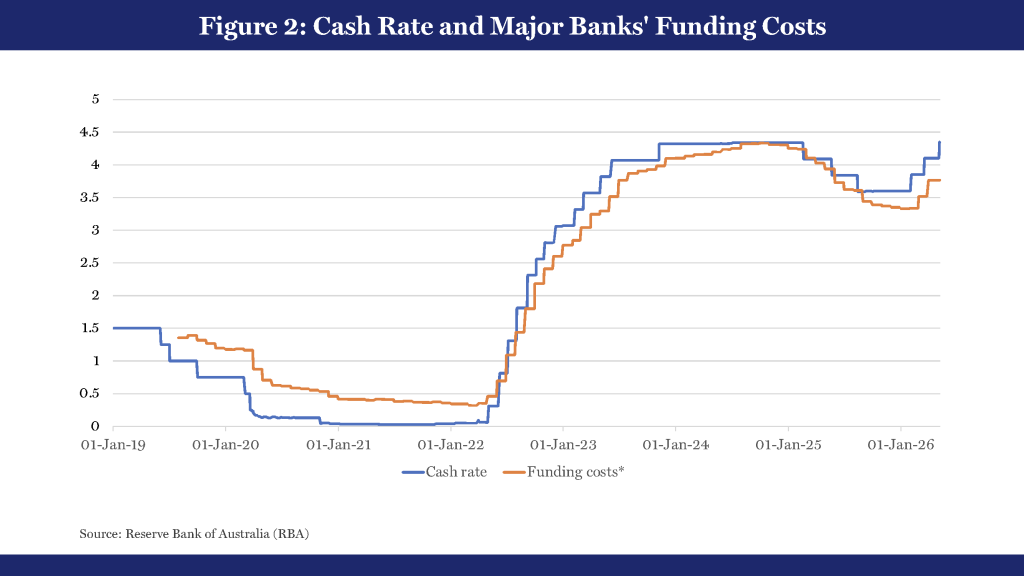
According to the Reserve Bank of Australia (RBA), major banks’ funding costs have declined relative to the cash rate since January 2025, which it attributes to interest-rate hedging costs that fell significantly in 2025 relative to previous easing phases.
“The rates banks paid on deposits and debt (before hedging) fell by a little less than the cash rate over 2025 and rose by a little less than the cash rate in early 2026, which is in line with past episodes when the cash rate was changed,” Australia’s central bank also reported. “However, actual funding costs may vary from our estimates, which rely on simplifying assumptions about hedging practices. Individual banks’ funding costs may also vary depending on their specific funding and hedging strategies.
>>>MIDDLE EAST AWARD WINNERS
BANKING CEO OF THE YEAR
Middle East
Mr. Tareq Abdulrahman Alsadhan
Saudi National Bank (SNB)
**********
BEST CUSTOMER SERVICE
PROVIDER OF THE YEAR
Middle East
Jordan Ahli Bank (Jordan)
**********
Best Commercial Bank Of The Year Bahrain
Kuwait Finance House (KFH)
Best Private Bank Of The Year Kuwait
NBK Wealth
Best Private Bank Of The Year Qatar
QNB Private
Best Private Bank Of The Year UAE
Mashreq
Best Innovation In Retail Banking Kuwait
National Bank of Kuwait (NBK)
Best Innovation In Retail Banking Oman
Bank Dhofar
Best Innovation In Retail Banking Saudi Arabia
Saudi National Bank (SNB)
Best Innovation In Retail Banking UAE
First Abu Dhabi Bank (FAB) | National Housing Loans (NHL)
Sustainable Bank Of The Year Jordan
Jordan Ahli Bank
Best Islamic Bank Of The Year Bahrain
Kuwait Finance House (KFH)
Best Islamic Bank Of The Year Oman
Dhofar Islamic
Best Mortgage Lender Of The Year UAE
First Abu Dhabi Bank (FAB) | National Housing Loans (NHL)
>>>ASIA & AUSTRALASIA AWARD WINNERS
BANKING CEO OF THE YEAR
Asia
Mr. Novan Amirudin
CIMB (Malaysia)
**********
BEST CUSTOMER SERVICE
PROVIDER OF THE YEAR
Asia
DBS Bank (Singapore)
**********
BANKING CEO OF THE YEAR
Australasia
Mr. Matt Comyn
Commonwealth Bank of Australia
**********
BEST CUSTOMER SERVICE
PROVIDER OF THE YEAR
Australasia
The Co-operative Bank (New Zealand)
**********
Best Banking Group Japan
Mitsubishi UFJ Financial Group
Best Banking Group Malaysia
Maybank
Best Investment Bank Of The Year Bangladesh
IDLC Investments
Best Investment Bank Of The Year China
CITIC Securities
Best Investment Bank Of The Year Japan
Nomura
Best Commercial Bank Of The Year Bangladesh
BRAC Bank
Best Commercial Bank Of The Year China
China Construction Bank (CCB)
Best Commercial Bank Of The Year Indonesia
Bank Mandiri
Best Commercial Bank Of The Year Kazakhstan
ForteBank JSC
Best Commercial Bank Of The Year Malaysia
CIMB
Best Commercial Bank Of The Year New Zealand
Bank of New Zealand (BNZ)
Best Commercial Bank Of The Year Philippines
Land Bank of the Philippines
Best Commercial Bank Of The Year South Korea
Hana Bank
Best Private Bank Of The Year Japan
Nomura
Best Private Bank Of The Year Singapore
DBS Private Bank
Best Innovation In Retail Banking Australia
Commonwealth Bank of Australia
Best Innovation In Retail Banking Brunei
Bank Islam Brunei Darussalam (BIBD)
Best Innovation In Retail Banking India
IDFC FIRST Bank
Best Innovation In Retail Banking Indonesia
Bank Danamon
Best Innovation In Retail Banking Japan
MUFG Bank
Best Innovation In Retail Banking New Zealand
ANZ Bank
Best Innovation In Retail Banking South Korea
Shinhan Bank
Best Innovation In Retail Banking Thailand
Government Savings Bank (GSB)
Sustainable Bank Of The Year Brunei
Bank Islam Brunei Darussalam (BIBD)
Sustainable Bank Of The Year China
CITIC Securities
Sustainable Bank Of The Year Indonesia
Bank Rakyat Indonesia (BRI)
Sustainable Bank Of The Year Malaysia
CIMB
Sustainable Bank Of The Year Philippines
Land Bank of the Philippines
Sustainable Bank Of The Year Thailand
Government Savings Bank (GSB)
Best Islamic Bank Of The Year Malaysia
Maybank
Best Mortgage Lender Of The Year Australia
Commonwealth Bank of Australia
Best Mortgage Lender Of The Year New Zealand
ANZ Bank
Best Mortgage Lender Of The Year Thailand
Government Housing Bank (GH Bank)