

 By Biagio Bossone, Advisor Consultant to International Organisations, Governments Agencies and Financial Institutions
One only has to remember what happened a hundred years ago to politics in pre-war Europe and observe the political dynamics playing out in the Western world today to recognize that deep and widespread economic and geopolitical uncertainties, middle-class impoverishment and social discontent all end up inevitably eroding the public’s trust in the democratic foundations of liberal societies: “the risk of democracy”.
Governments should invest huge resources to rebuild public trust by courageously attacking these problems at their roots while making deep social commitments, especially toward the many who today are suffering from the contradictions of capitalism—unparalleled income inequalities, unprecedented technological and labor-market disruptions, unaffordable housing, stagnant wages, growing healthcare costs, climate change, higher prices of energy and strategic resources, as well as growing pressures from migration, to cite a few.
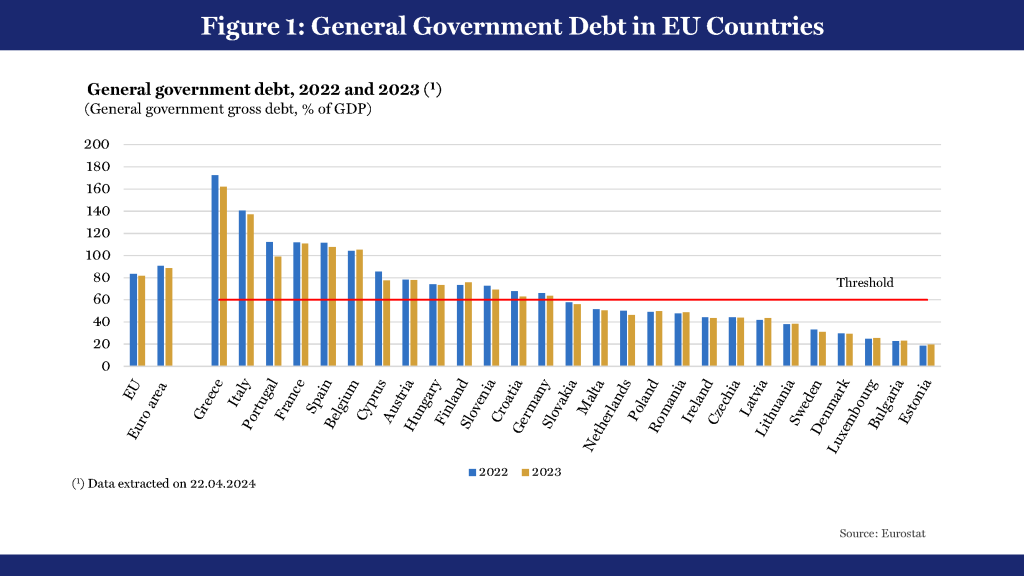
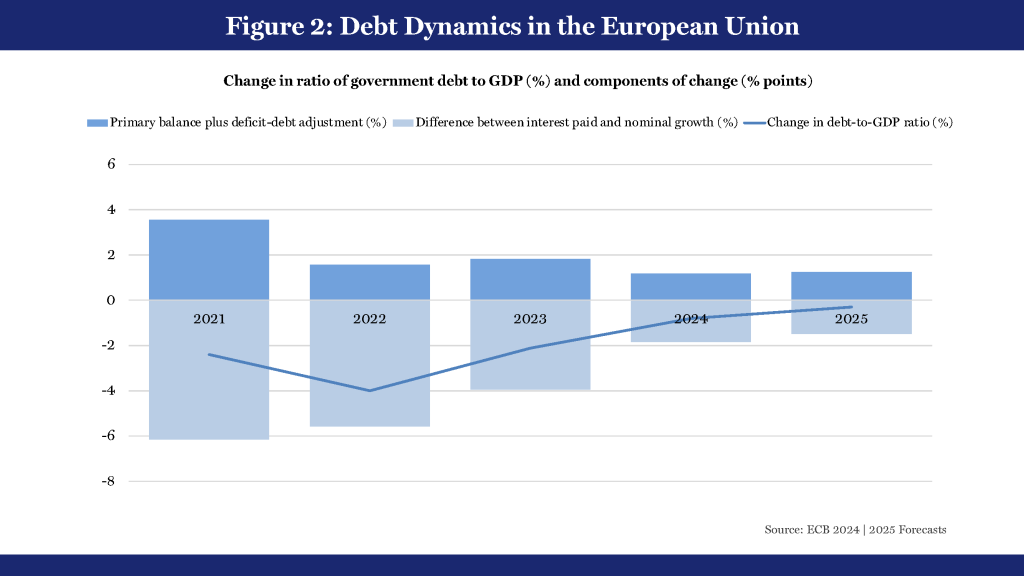
Yet, precisely at a time when governments should mobilize large resources for their societies, they have very limited fiscal space available and find themselves unprepared to respond to people’s needs. In Europe, government debts are high in several countries (Figure 1), and even the modest debt reductions achieved in recent years have ground to a halt (Figure 2).
It is not surprising that political parties, which vie for power by making lavish promises during elections or propose bold alternative programs when they are out of office, face the grim reality of large debt burdens once they take office. Suddenly, reality cools down their electoral enthusiasms and compels them to follow the same limited budgetary course, much to the electorate’s chagrin.
Economists hold different views on what should be done. Some argue in favor of pursuing long-term programs of sustained fiscal primary surpluses to pay off debts, though this would obviously prompt further social discontent and cause even more political extremism. Others recommend implementing structural reforms to reduce the incidence of debt by raising the gross domestic product (GDP), except that the costs of such reforms would largely fall upon those same groups that suffer the most from current economic troubles. Others advocate for lowering debt-to-GDP ratios by boosting public or private spending, but fiscal multipliers are very uncertain, and nobody knows for sure what the ex-post outcomes would be.
In the end, none of the above proposals are implemented because they are too socially costly and politically risky. The inertia makes the debt issue even bigger, and so politics and civil society continue ignoring the problem, feeling helpless to change it.
A feasible solution
A solution indeed exists. It is unconventional and yet fits European norms, and it would bring quick and substantial benefits at manageable social costs. However, since it could only be applied once, there should be a lasting promise to prevent the problem from happening again.
The solution draws on the Politically Acceptable Debt Restructuring in the Eurozone (PADRE) proposal put forward years ago for the highly indebted countries of the euro area by Pierre Pâris and Charles Wyplosz—certainly not two economists who can be accused of heterodoxy, anti-Europeanism or “no-euroism”.
Accordingly, an agreement would be struck between the national governments of the highly indebted eurozone countries and the European System of Central Banks (ESCB) under the aegis of European Union (EU) institutions, whereby the European Central Bank (ECB) and the relevant national central banks (NCBs) would purchase a share of the countries’ public debts on the secondary market over a given time window in exchange for cash, simultaneously issuing an equal amount of debt obligations (Notes) in the market and/or in exchange for debt notes (Notes).
The share of debts purchased by the NCBs would be determined to cut outstanding public-debt stocks to below a pre-agreed sustainable debt-to-GDP ratio. The debts acquired would be transformed into perpetuities bearing zero interest, thus de facto canceling them. This transformation would amount to a debt-restructuring operation, but it would involve only the debts acquired by the NCBs.
Since the NCBs would pay interest on the Notes issued but receive no interest on the perpetuities, they would make losses (or incur lower profits), which they would recover over time through three channels:
- Retaining the seigniorage they transfer every year to their national governments,
- Withholding the taxes they owe to governments annually and
- Receiving annual shares of any extraordinary fiscal revenues raised by governments (to accelerate the cost-recovery process).
The nature of the NCBs as euro-issuing entities would reduce the Notes’ interest costs, and it would also ensure that the NCBs continued to function effectively in their capacities as monetary-policy institutions—without impairing their institutional responsibilities and capacities to fulfill them, even if running losses (or incurring lower profits) for long periods of time.
The proposed solution’s impacts
On the monetary side, the NCBs’ debt purchases via either of the above two options would not implicate any debt monetization, because issuances of new money would be offset by equal issuances of Notes.
On the fiscal side, the debt operations would enhance the repayment capacities of the public sectors of the countries involved, improve the countries’ risk profiles and reduce the costs of servicing the residual debts (after the NCBs’ purchases). Fiscal space would be regained.
The proposed solution would shift the costs of debt operations to the future generations of the countries involved in the form of reduced future budget revenues (through the three channels indicated above). Yet, by helping governments fix the present fault lines of their societies, this solution would allow them to create much better economic and political conditions than today’s for those future generations to thrive.
Importantly, this solution would not require transfers from other countries inside or outside the eurozone, nor would it impose costs on creditors. The debt-purchase operations would fully fund themselves eventually, meaning that in the end, indebted countries would repay their own debts.
The Notes’ cost recovery would take a long time. As Pâris and Wyplosz have shown, assuming normal GDP and interest-rate dynamics, several decades would be required before the cost burdens would decrease relative to the growing savings—up to a point where central banks’ revenues would start topping the costs. In any case, only central banks would have the necessary “patience” for recovering costs so far in the future, possessing the financial capacity to operate effectively even under protracted losses, as noted.
True, the ECB and NCBs would not like this prospect. Yet, they should realize that they are not at all disconnected from “the risk of democracy”, and their own independence and functions would be in jeopardy if political extremism were to prevail. It would then be much better for them to be wise, engage constructively in a solution like the one discussed here and accept a less-than-ideal present prospect to prevent a much-less-than-ideal future one.
Moral hazard
Inherent to the proposed solution is the risk of moral hazard: With fiscal space regained, governments could be tempted to resort to new irresponsible borrowing programs. To prevent this problem, no agreement should take place without the countries involved solemnly committing to exercising credible restraints against that risk.
This could involve the parliaments of these countries committing their present and future national governments not to exceed the agreed sustainability level and to allocate the regained fiscal space to support only specific national priorities. In cases of violations, a corresponding share of perpetual zero-coupon bonds (into which the debts acquired by the NCBs have been transformed) would be re-converted into ordinary short-maturity, market-rate-bearing bonds, thereby re-becoming debts, which governments would then be obliged to honor.
The economic and political consequences triggered by this condition should discourage governments from engaging in violations.
Conclusion
The proposed solution, inspired by the PADRE plan, offers a pragmatic approach to debt restructuring. Through it, with the strongest political support from EU institutions, European countries can regain fiscal capacity and support democracy without imposing costs on other nations or creditors. This solution would align with European norms and promise substantial benefits at manageable social costs.
Adopting it would not only address immediate debt burdens but also restore public trust in democratic institutions by demonstrating a commitment to responsible and effective economic governance. It would enable governments to better meet their citizens’ needs, fostering social stability and resilience in the face of ongoing and future challenges.
In conclusion, while implementing such a solution would certainly not be simple, the innovative and collaborative approach to debt management underpinning it would provide the necessary support to the foundations of democracy, built on the reduction of today’s increasing social exclusion and the recovery of people’s welfare.
This proposed solution underscores the importance of fiscal responsibility and international cooperation and the need for policies that prioritize long-term social and economic well-being.
_ _ _
Disclaimer: The views and opinions expressed in this article are solely those of the author and do not necessarily reflect the views or position of any of the institutions in which he is associated.
_ _ _