


 By Matteo Aquilina, Adviser for Financial Stability, and Nikola Tarashev, Head of Secretariat, Committee on the Global Financial System, Bank for International Settlements (BIS)
Over the past two decades, the heft of non-bank financial intermediaries (NBFIs) has grown, and so has their interdependence with banks. NBFIs provide funding to banks and count on banks to make markets. In addition, NBFIs and banks have a similar investor base and are active in similar asset classes (Viral V. Acharya et al., 2024 and Andres Aradillas Fernandez et al., 2024).
In this article, we summarise a study (Aquilina, Cornelli and Tarashev, 2025) that sheds light on whether strain at investment funds tends to contribute to a tightening of market conditions when market pressure on banks intensifies from an elevated level. Such joint dynamics could undermine financial stability.
We gauge the state of the banking sector via price-based measures of default risk and of the investment fund sector via the magnitude of redemptions. We use credit default swap (CDS) spreads to identify episodes of low and high market pressure in the banking sector, as well as to capture how strain evolves within such episodes. (Reflecting the premium that investors demand for taking on a credit exposure, CDS spreads are standard indicators of banking sector stress [Davide E. Avino et al., 2019 and Martin Indergand et al., 2022]). For investment funds—concretely, prime money market funds (MMFs), corporate bond exchange-traded funds (ETFs) and open-ended corporate bond mutual funds (MFs)—we measure strain using net flows relative to assets under management. (Prime funds hold short-term government securities, repos backed by such securities, and commercial paper and certificates of deposit. The exposures of prime MMFs have shorter maturities and typically go to higher-quality borrowers than those of bond MFs or bond ETFs.) While low leverage at these funds implies minimal default risk, material liquidity transformation makes them vulnerable to investor outflows that could force fire sales.
We consider a broad range of historical episodes as featuring “high market pressure” in the banking sector. In addition to systemic events, we include more benign spells that only held the potential to affect financial stability. In the latter episodes, banks may have succeeded in reassuring markets, with or without assistance from the public sector. Alternatively, investment funds’ actions may have counterbalanced the pressure on banks.
Our key findings refer to instances in which market pressure in the banking sector intensifies from a high level. In such a scenario, we find that—even though strain evolves similarly across the three investment-fund sectors—the attendant implications for market conditions are different. Concretely, net flows tend to decline at bond MFs, bond ETFs and prime MMFs alike—a commonality with banks that has strengthened materially over time. That said, only the bond MF sector tends to experience outflows. Since there is evidence that these outflows often trigger sales of illiquid assets, bond MFs tighten market conditions at an unfavourable time for banks. (Identifying causal links is beyond our scope. We are silent as to whether the joint evolution of strains at banks and investment funds originates in a specific sector or is the outcome of a market-wide risk-off environment.)
Fund flows and market pressure on banks
We measure the commonality of strains at investment funds and banks in two subperiods—from January 2006 to December 2013 and from January 2014 to August 2024. The earlier subperiod roughly coincides with strong growth in the overall NBFI sector, whereas the size of this sector was stable at a high level during the later subperiod (Financial Stability Board, 2024). In addition, the number and length of high-pressure episodes were roughly the same in the two subperiods.
Strain commonality with banks is particularly high—for each investment fund type in focus—within episodes of high market pressure in the later subperiod. This is an outcome of rising commonality under pressure. (This echoes a finding in Viral V. Acharya et al., 2024 on commonalities between the banking and the broad NBFI sectors. They find that: (i) the systemic-risk contributions of these two sectors have become more correlated since the Global Financial Crisis (GFC); and (ii) returns in each of the sectors cause—in a statistical sense—returns in the other.) We see this by comparing bars of the same colour across the panels in Figure 1, where we calculate the correlation between CDS-spread changes and the negative of net fund flows—thus, a higher correlation implies stronger commonality. While the correlations were below 30 percent (and statistically not different from zero) in high-pressure episodes during the earlier subperiod, they rose to above 50 percent (and became statistically significant) in the later subperiod. By contrast, the corresponding correlations in low-pressure episodes barely moved (blue bars). The phenomenon is starkest in the bond MF sector, in which the low-pressure correlation declined slightly but the high-pressure correlation shot up from effectively zero to about 80 percent.
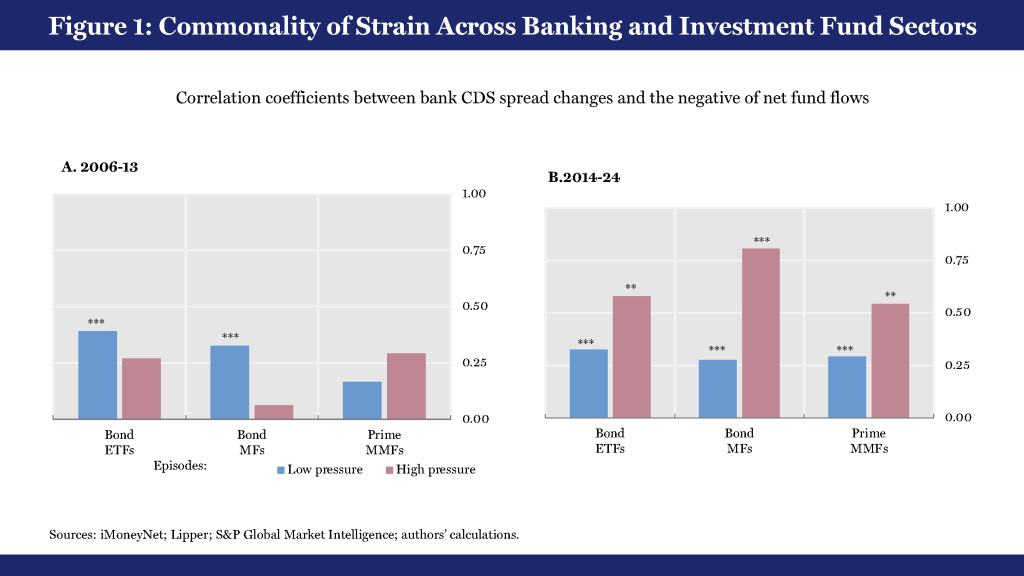
1 Our data cover 53 large banks from 15 jurisdictions. Episodes of high/low market pressure on banks are defined in Aquilina et al (2025). The open-ended corporate bond mutual funds (MFs) and the corporate bond exchange-traded funds (ETFs) are among the top 500 funds worldwide by AUM in each category. The prima money market funds (MMFs) are among the top 500 US-domiciled funds in this category. ***/** indicates statistical significance at the 1/5% level. The change in high-pressure (low-pressure) correlations between the two subperiods is statistically significant at the 1% level (insignificant).
The findings for the later subperiod (Figure 1.B) are consistent with investors perceiving greater similarity between banks and funds during high-pressure episodes. When market pressure is low, a common investor base would exploit diversification benefits by rebalancing its positions across sectors. In such episodes, there is thus a relatively high likelihood that an increase in banks’ CDS spreads would occur together with fund inflows. In contrast, common risk factors come to the fore during episodes of high market pressure in the banking sector. In such circumstances, investors both demand higher compensation for credit exposure to banks and retrench from investment funds.
For market conditions, it is crucial to determine whether the above correlations reflect the evolution of inflows or outflows. While declining inflows would not force fire sales of fund assets, rising outflows could. For this reason, we next consider the level of investor net flows in episodes of low and high market pressure.
Distribution of fund flows
The distribution of net investor flows differs markedly across sectors (Figure 2).
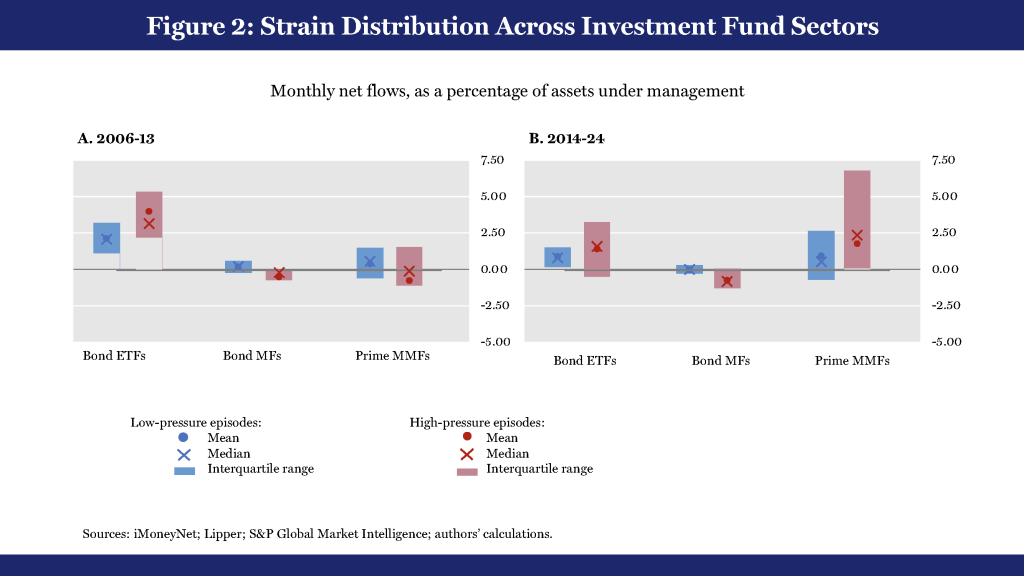
1Episodes of low/high market pressure on banks are defined in Aquilina et al (2025).
The picture is rather benign for bond ETFs and prime MMFs. In each subperiod, bond ETFs tend to face higher net flows—mostly inflows—when banks are under high market pressure (Figure 2, red versus blue bars). This finding squares with the contrarian behaviour of bond ETF investors, supported by these funds’ business models (Karamfil Todorov, 2021). The experience of prime MMFs is similar, especially over the later subperiod, probably reflecting the relative safety of these funds’ portfolios.
The picture is much less benign in the case of bond MFs. Here, higher market pressure on the banking system tends to go together with lower net flows. While inflows and outflows are roughly equally likely in low-pressure episodes, outflows occur 75 percent of the time in high-pressure episodes. Again, this pattern persisted through both subperiods, consistent with strong incentives for a run on bond MFs in a risk-off episode.
The distributions of net flows (Figure 2) refine the interpretation of the correlation results (Figure 1). In the later subperiod, for instance, an intensification of high market pressure in the banking sector tends to coincide with declining inflows to bond ETFs and prime MMFs but with rising outflows from bond MFs (Figures 1.B and 2.B, red bars).
Liquidity matters—especially at bond MFs
If market pressure on banks increases further from an already elevated level, are outflows from bond MFs likely to force fire sales? Focusing on the 2014-24 sub-period, we obtain two sets of findings that support an affirmative answer.

*** indicates statistical significance of the associated coefficient at the 1% level. Monthly data from January 2014 to August 2024. The sample is limited to funds with available data on cash holdings (bond MFs and bond ETFs) or (liquid) assets maturing within a week (prime MMFs). “High-liquidity” funds are those in the top quartile in terms of the average ratio of cash or liquid assets to total assets under management (AUM). For a fuller description of the underlying analysis, see Aquilina et al (2025).
First, we find that in episodes of high market pressure, funds come under greater strain when their liquidity positions are weaker (Figure 3.A). We say that a fund is more liquid if the share of cash in its assets is higher. In the bond MF sector, the average net flow (1-percent outflow) tends to decline by 0.5 percentage points for high-liquidity funds when the banking sector’s CDS spread increases by one standard deviation. At 0.8 percentage points, the corresponding decline in low-liquidity bond MFs—from an average 0.8-percent outflow—is significantly larger in statistical terms. The results are qualitatively similar for bond ETFs and prime MMFs.
Second, we zoom in on the bond MF sector to investigate the evolution of cash buffers at the level of individual funds, again focusing on episodes of high market pressure on banks. For each of the four such episodes from 2014 to 2024, we refer to the initial cash buffer of each bond MF in our sample and the changes in this buffer over the episode. This leads to the scatter plot in Figure 3.B. Consistent with previous research (Stephen Morris et al., 2017), bond MFs with lower cash buffers tend to reduce these buffers by less or even expand them by selling other assets. In other words, such funds not only face larger outflows but are also more likely to sell illiquid assets, which would contribute to a tightening of market conditions.
Conclusion
Investor flows that lead to fire sales of funds’ assets would be of greater systemic relevance if they occur when market pressure on banks is already high. This is the case irrespective of whether the fund flows contribute to, or are a consequence of, the pressure on banks, or whether the two developments are a joint manifestation of external risk factors. Either way, financial stability is jeopardised.
We document that investment-fund sectors differ in their tendency to experience such destabilising flows. Consistent with salient features of their business models, bond ETFs tend to attract investors when banks are under high market pressure. By contrast, over the past decade, the bond MF sector has generally faced large outflows, leading to fire sales at the same time as high market pressure on banks escalates. This underscores the macroprudential value of reforming the bond MF sector—for example, with liquidity-management tools that reduce investors’ first-mover advantage (Lewrick and Claessens, 2021). Indeed, the Financial Stability Board (FSB) and the International Organization of Securities Commissions (IOSCO) have recently published recommendations on this topic (FSB, 2023 and IOSCO, 2024).
Nikola Tarashev heads the Secretariat of the Committee on the Global Financial System, which is in the Monetary and Economic Department of the Bank for International Settlements (BIS). Previously, Nikola was the Head of Financial Systems and Regulation from 2018 to 2023 and the Managing Editor of the BIS Quarterly Review from 2020 to 2023. From 2015 to 2018, he was the Special Adviser to the General Manager of the BIS on Financial Stability Policy. From 2010 to 2012, he was a part-time Consultant in the Prudential Policy Division of the Bank of England (BoE). Nikola joined the BIS in 2002, after completing his Ph.D. in Economics at Princeton University.