

 By Dr. Anderson Caputo Silva, Division Chief of Connectivity, Markets and Finance, Inter-American Development Bank (IDB)
The international development finance (IDF) ecosystem is entering a new era—one in which investors, multilateral organizations, financial intermediaries and final beneficiaries are more interconnected than ever. This convergence is unlocking innovation, scaling private-capital mobilization and opening new investment opportunities that align private incentives with the public good. At the center of this shift stand multilateral development banks (MDBs); their ability to blend financial engineering with policy dialog makes them critical brokers in linking public ambition with private capability.
The evolving role of multilateral development banks in closing the financial gap
Traditionally, MDBs have been the main source of long-term development finance, accounting for two-thirds of all official financing. Today, they are spearheading efforts to attract private investment to close the estimated $4.2-trillion annual financing gap facing emerging and developing economies (EMDEs) to meet their Sustainable Development Goals (SDGs).
This evolution reflects growing urgency; financing needs for resilience, infrastructure, health and education far exceed the fiscal space available to many economies. To meet this challenge, MDBs have been strategically optimizing their balance sheets to expand lending capacity and mobilize investments.
Through guarantees, blended-finance mechanisms, de-risking tools, grants and technical assistance, they are catalyzing greater private-sector participation in development projects.
Through guarantees, blended-finance mechanisms, de-risking tools, grants and technical assistance, they are catalyzing greater private-sector participation in development projects. Importantly, these institutions now regard innovation not merely as an end goal but as a powerful means to expand development impact and drive systemic change.
Capital markets: Scaling impact through sustainable bonds
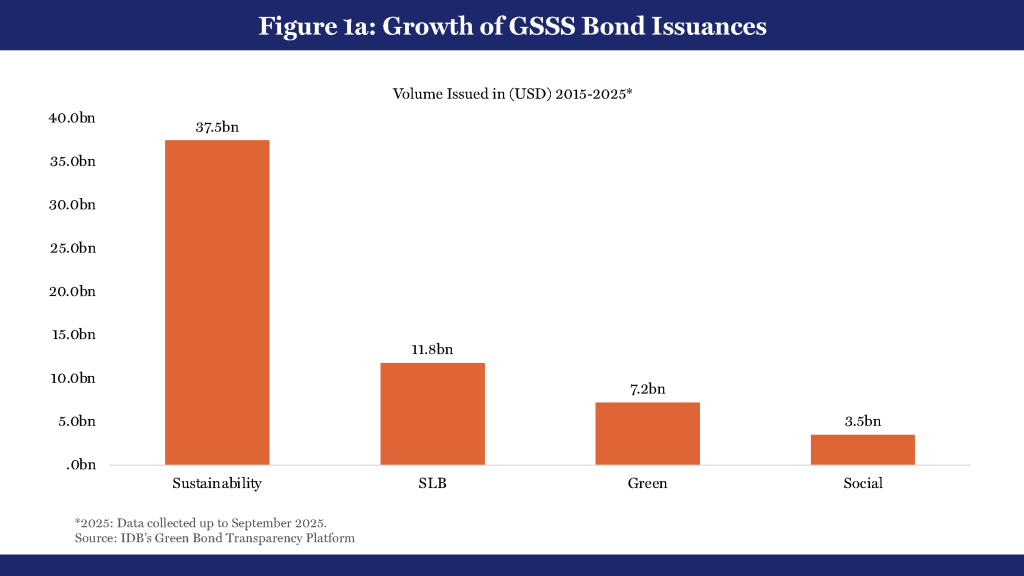
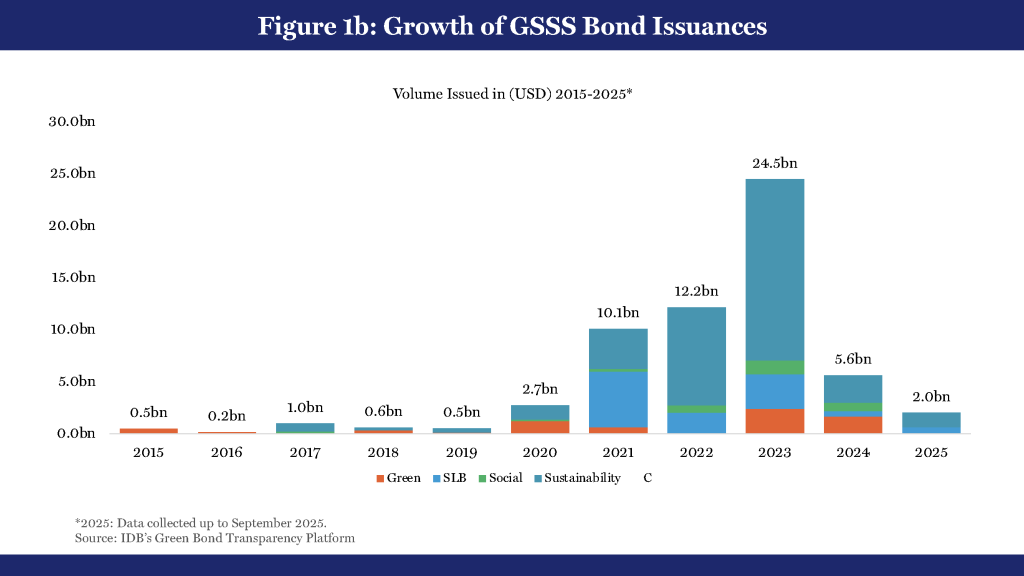
Capital markets have emerged as one of the most powerful conduits for development finance in recent years. The surge in Green, Social, Sustainability and Sustainability-Linked (GSSS) bonds demonstrates how public and private actors can work together to mobilize funding at scale. Industry groups such as the International Capital Market Association (ICMA) have raised transparency and accountability standards, while MDBs have helped countries and issuers build the capacity to meet them.
Through technical assistance, guarantees and targeted grants, MDBs such as the Inter-American Development Bank (IDB) have enabled governments and corporations to issue credible GSSS bonds that attract private investors. In Latin America and the Caribbean (LAC), landmark transactions include Chile’s and Uruguay’s sustainability-linked bonds, Brazil’s recent sustainable issuances and the launch of the Amazonia Bond Issuance Program—anchored on guidelines developed jointly by the IDB and the World Bank.
The IDB recently announced a $1-billion Amazonia Bond program to channel private capital toward the protection and sustainable use of one of Earth’s most vital biomes.
Guarantees and debt swaps: Bridging public and private capital
Another powerful tool driving public–private collaboration is the growing use of guarantees. Once confined to traditional infrastructure projects, guarantees are now being deployed to back a wider range of development initiatives, ranging from climate resilience to education. MDBs and their partners are using these instruments to unlock investment flows and attract new participants, including insurers and institutional investors.
Among the most promising innovations are commercial debt swaps, which convert portions of sovereign debt into investments in conservation or social programs. These so-called “debt-for-development swaps” create fiscal space while directing savings toward priority areas, such as marine protection, water resilience and education. The IDB has participated in five of the ten commercial debt swaps executed to date and co-leads a Credit Enhancement Task Force launched at COP28 (2023 United Nations Climate Change Conference) to standardize best practices. It has also been invited by Prime Minister Mia Mottley of Barbados to coordinate with other MDBs on a multi-guarantor facility to scale up regional debt-swap mechanisms.
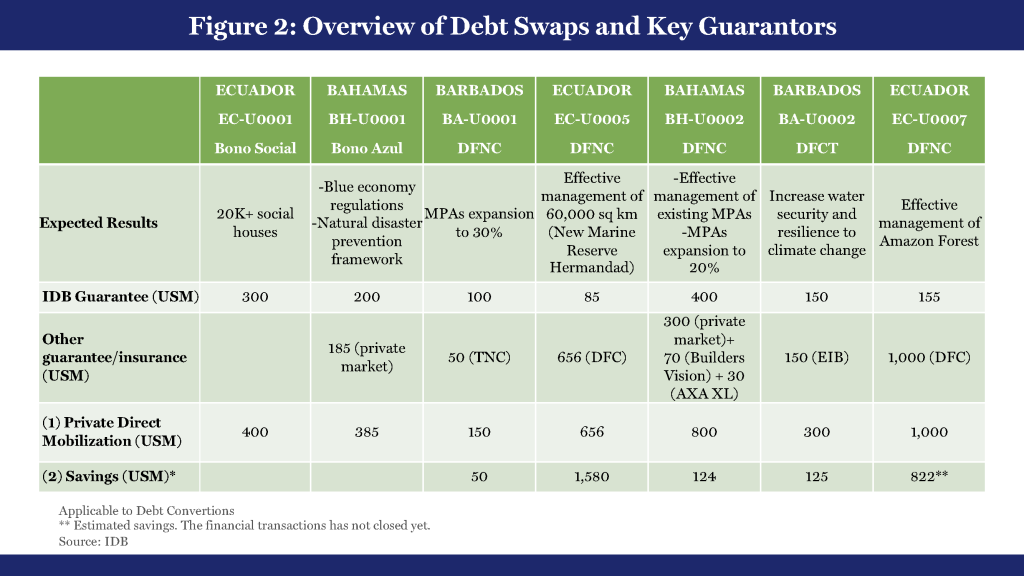
- Direct mobilization: Private-sector financing commitments on commercial terms.
- Savings: Reduction in debt-related payments (principal and/or interest) in connection with the swap.
Disaster-risk financing: Sharing risk in an age of uncertainty
As natural disasters grow more frequent and severe, developing economies are rethinking how to manage financial risks. Private insurance is often too costly or unavailable, leaving governments exposed to devastating fiscal shocks.
MDBs and development partners are supporting a tiered approach that matches tools to risk levels: ex-ante prevention and capacity building for frequent, low-impact events; climate-resilient debt clauses to ease repayment burdens after disasters; and contingent credit lines for emergency responses. These layers pave the way for risk transfers through capital markets, including catastrophe bonds and swaps.
The IDB’s FIRRe initiative, launched in Seville, Spain, during the 4th International Conference on Financing for Development (FfD4) in July 2025, reinforces this comprehensive framework by committing to expand Climate Resilient Debt Clauses (CRDCs), increase contingent credit facilities and promote market-based risk-transfer solutions.

Banking systems and PDBs: Financing the real economy
A vibrant and inclusive banking system remains essential to broad-based development. Across Latin America and the Caribbean, public development banks (PDBs) have proven to be essential MDB partners for scaling access to finance for micro, small, and medium-sized enterprises (MSMEs), which represent the main source of employment and productivity in the region, and for channeling resources to strategic sectors, such as agriculture, infrastructure and housing, that still face barriers to affordable, long-term credit.
Across Latin America and the Caribbean, public development banks (PDBs) have proven to be essential MDB partners for scaling access to finance for micro, small, and medium-sized enterprises.
Leveraging their local-market knowledge and capillarity, PDBs help overcome structural barriers that limit access to credit, often acting as second-tier lenders, channeling funds through commercial banks and cooperatives with local reach. The IDB’s partnerships across Latin America and the Caribbean illustrate how MDBs and PDBs, working together and with the participation of the broader financial sector, can extend credit, strengthen financial management and promote gender inclusion and climate resilience among MSMEs and other key sectors. For example, in the last decade, the IDB approved more than 75 loan operations with 40-plus PDBs in 17 countries, totaling more than $9 billion and leveraging twice that in additional SDG-aligned investments.
These activities need to be well crafted to address market failures that hinder direct flows of financing to underserved segments and productive sectors and to crowd in private capital. MDBs also engage in significant monitoring, evaluation and impact-measurement efforts, ensuring that development finance remains accountable and effective.
Digital finance and financial inclusion: Building the digital backbone
Digital transformation is reshaping finance faster than any previous wave of innovation. Governments are modernizing regulations and building digital public infrastructures—such as instant-payment systems and open-finance frameworks—while fintechs (financial-technology firms) are bringing technology and agility to serve new customer segments. Together, these advances are not only improving inclusion but also creating the data, efficiency and transparency needed to assess risk and deploy private capital.
The IDB’s “Beyond Cash: The Digital Payments Revolution in Latin America and the Caribbean” report highlights how coordinated reforms in digital payments can cut costs and expand access across Latin America and the Caribbean. When paired with strong consumer protection and interoperability, these systems empower the use of data analytics to design credit, savings and insurance products tailored to underserved populations, thereby deepening financial inclusion, strengthening intermediation and increasing capital flows through the economy, opening new pathways for private investments.
The IDB has launched a new initiative to help countries design and implement fast retail-payment systems and other digital financial infrastructures—ensuring that inclusion and innovation move hand in hand, while creating more open, efficient and trusted financial ecosystems that can attract greater private-sector participation.
National platforms for capital mobilization: From vision to scale
A promising new frontier lies in the creation of national platforms that connect development priorities with private investments. Brazil’s Eco Invest program offers a compelling example. Combining blended finance, FX (foreign exchange) derivatives, liquidity facilities and project-structuring tools, the program supports Brazil’s Ecological Transformation Plan by mobilizing private capital for sustainable projects.
In its first two blended-finance auctions, Eco Invest attracted billions in private commitments for sectors such as renewable energy and sustainable infrastructure. The IDB has supported the initiative from its inception—helping design innovative FX-hedging solutions and reforms to improve the investment climate—with support from the government of the United Kingdom.
Building on this success, the IDB, Brazil and the United Kingdom launched the FX EDGE program this year to expand these solutions regionwide, offering tailored financial instruments and policy support to align private investment with national development goals.
Moving beyond public budgets
Across capital markets, with the strategic use of MDB guarantees, disaster-risk tools, MSME financing and digital finance ecosystems, one message stands out: Development finance is no longer confined to public budgets.
By harnessing the strengths of all actors—governments, MDBs, investors and innovators—the global community can transform the way capital serves development. Public–private synergy is not just a trend; it is the foundation of a more inclusive, resilient and sustainable financial future.
Anderson Caputo Silva is the Chief of the Connectivity, Markets and Finance (CMF) division of the IDB since July 2023. He was formerly Practice Manager for Long-Term Finance and Lead Financial Sector Specialist in the Finance, Competitiveness, and Innovation Global Practice at the World Bank, focused in the areas of capital market development and sustainable finance. Previously, Anderson held several roles at the Brazilian Treasury, including serving as Head of the Public Debt Strategic Planning Department. In that capacity, Anderson was responsible for formulating strategies for the government’s debt portfolio across both domestic and international capital markets. He holds a Ph.D. degree in Finance from the University of Illinois at Urbana-Champaign.