

 By Dr. Armida Salsiah Alisjahbana, United Nations Under-Secretary-General and Executive Secretary, Economic and Social Commission for Asia and the Pacific (ESCAP)
Despite significant strides over the three decades since the adoption of the Beijing Declaration and Platform for Action in 1995, the Asia-Pacific (APAC) region continues to grapple with entrenched disparities that prevent women from realizing their full potential.1 Economic inequality, underrepresentation in leadership roles and gender-based violence remain persistent challenges, compounded by intersecting crises such as climate change and the aftermath of the COVID-19 pandemic. Gender equality and women’s empowerment are not just moral imperatives; they are critical drivers of economic growth, social stability and sustainable development.
This article focuses on policies and initiatives that have successfully advanced gender equality across Asia and the Pacific, including strategies that address economic empowerment, leadership representation and gender-based violence. It highlights impactful reforms and effective approaches that are driving meaningful progress towards gender equality.
Economic empowerment: a foundation for resilience
Economic inequality continues to hinder gender equality across the region. Persistent gender gaps in nutrition, health and education place women and girls at higher risk of multidimensional poverty, especially women with disabilities, rural women and female migrants in urban areas. Women’s disproportionate share of unpaid care work significantly limits their participation in the labor market, with many engaged in informal, low-wage jobs. This perpetuates income inequality, with women in the region earning just 44 cents for every dollar earned by men,2 making women particularly vulnerable to poverty and economic insecurity, especially during crises.
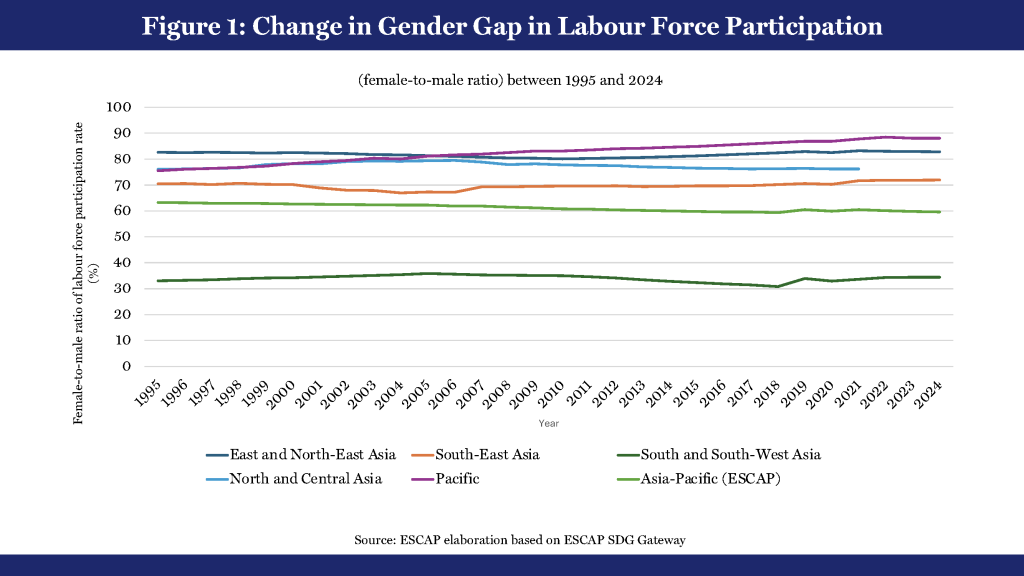
Labour force participation (ILO est.) 15+, by sex, percentage (accessed July 27, 2024). Data presented in the ESCAP database was retrieved from ILOSTAT on November 28, 2023. The gender gap is calculated as the female-to-male ratio of the labour force participation rate. The latest estimate for North and Central Asia is available for only 2021.
Countries across the region are recognizing the critical importance and tremendous value of care work. Investing in the care economy not only reduces the unpaid care burden on women but also creates new job opportunities. Cambodia has made significant investments in care infrastructure and services to reduce and redistribute unpaid care work, advancing women’s economic empowerment. Key initiatives include improving rural water, sanitation and road infrastructure; expanding early-childhood education; and supporting care for older persons through community-based programs.
By shedding light on the extent of the gender pay gap, Australia and New Zealand have spurred further action to address underlying pay gaps, including occupational segregation and the underrepresentation of women in leadership. In Australia, gender pay-gap data is public, and large employers are required to develop gender-equality policies. New Zealand has adopted an intersectional approach to closing gender, Māori, Pacific and ethnicity-based pay gaps in the public-service sector through publishing annual pay-gap data, addressing biases in salaries, promoting equitable career pathways and improving representation in leadership.
Social protections remain underfunded, with limited coverage and inadequate benefits for women. For instance, less than one-third of women of working age in the Asia-Pacific region are covered by old-age pension schemes, compared to 44 percent of men.3 Even when covered, women often receive lower benefits due to their reduced contribution capacity, driven by labor-market discrimination and disproportionate unpaid care responsibilities.
Social-protection schemes that account for women’s care responsibilities are essential for building economic resilience. Armenia’s pension system offers care credits, recognizing the time spent caring for children as part of the service required for old-age pensions. For one parent, up to six years is credited for the time spent caring for children under the age of 2, ensuring that caregiving does not lead to long-term income insecurity.
Gender disparities are also pronounced in education and skills training. While girls in the region who are enrolled in primary and secondary schools are more likely than boys to complete their educations, women and girls lag in tertiary education, particularly in science, technology, engineering and mathematics (STEM) fields. This gap leaves women less prepared to access decent jobs in growing sectors such as the digital and green economies. To mitigate the situation, several ministries in Thailand partnered with a major tech company to provide targeted upskilling and reskilling to prepare youth and adults—particularly those at risk of exclusion, the majority of whom were women—for careers in the digital economy.
Enabling entrepreneurial ecosystems is another strategy to empower women economically. Measures such as simplifying business registration, providing access to microfinance and offering business-development support have helped women entrepreneurs in Samoa, where nearly half of micro, small and medium-sized enterprises (MSMEs) are now led by women.
Representation and leadership: driving systemic change
Women remain underrepresented in leadership and decision-making roles across the Asia-Pacific, with data showing that the region lags behind the global average. Only one in five parliamentary seats is held by a woman,4 and women make up just one in eight government ministers.5 Even when women are in leadership roles, they often hold portfolios traditionally associated with family or gender affairs, with limited representation in areas such as finance, foreign policy or technology. Representation is not just about numbers—it is about shifting power dynamics and ensuring that women have equal voices in shaping policies and decisions that affect their lives and communities.
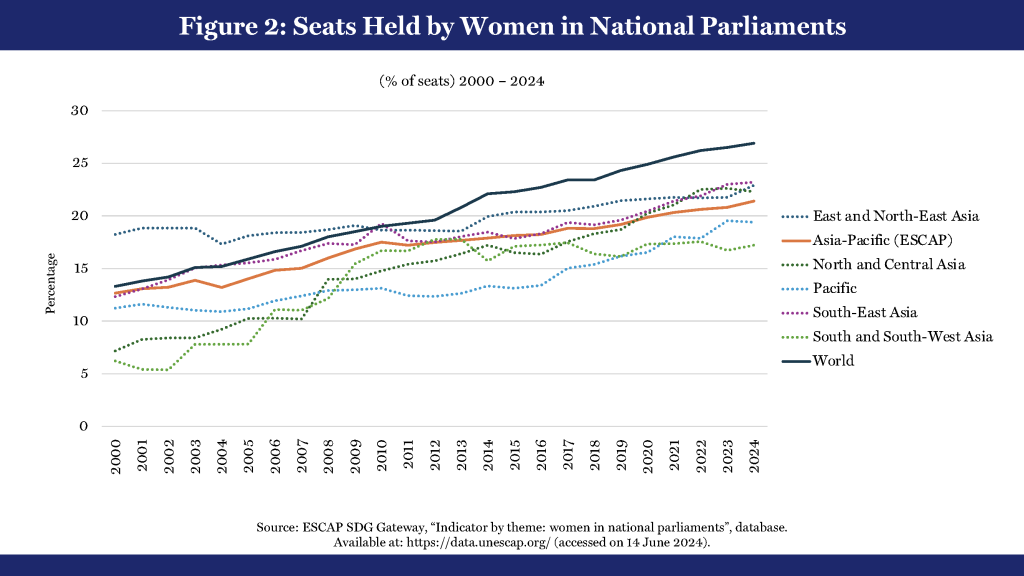
Affirmative measures and capacity-building initiatives are essential for increasing women’s participation in decision-making and addressing leadership gaps. In Mongolia, recent amendments raised the gender quota for political-party candidates to 30 percent for the 2024 elections and 40 percent for 2028, and further progress has been incentivized through state funding for parties exceeding these quotas. Complementing these legislative changes, Mongolian political parties have introduced internal reforms, including financial support for female candidates and mentorship programs, to help women overcome barriers to leadership.
Across the private sector, women’s presence in senior management and on corporate boards also lags behind. Addressing the structural barriers that prevent women from entering leadership roles requires deliberate action across sectors. Malaysia has made strides in corporate leadership by mandating that all publicly listed companies have at least one board member who is a woman. This policy, combined with campaigns to have women comprise at least 30 percent of board members, has driven progress toward gender balance on corporate boards.
Protection from violence: a prerequisite for equality
Gender-based violence remains a pervasive and harmful barrier to gender equality across Asia and the Pacific. Estimates show that more than one in four women aged 15 to 49 in the region have experienced physical and/or sexual intimate-partner violence, while many others face risks of violence and harassment in public spaces, workplaces and digital environments.6 Women and girls are also overrepresented among victims of human trafficking. The societal and economic costs of gender-based violence are immense, affecting not only the victims but also placing heavy burdens on healthcare, justice and social-support systems.
Institutionalizing comprehensive action plans for gender-based violence prevention and response is vital. Fiji’s National Action Plan to Prevent Violence Against All Women and Girls (2023–2028) offers a whole-of-society approach, supported by dedicated resources and measurable objectives.
Despite reductions over the past three decades, many countries in Asia and the Pacific still have alarmingly high rates of child marriage. A form of gender-based violence, child marriage predominantly affects girls, denying them education, health and security and exposing them to early pregnancy, health complications and increased vulnerability to violence. Child marriage also diminishes educational and economic opportunities, perpetuates cycles of poverty and carries significant economic costs.
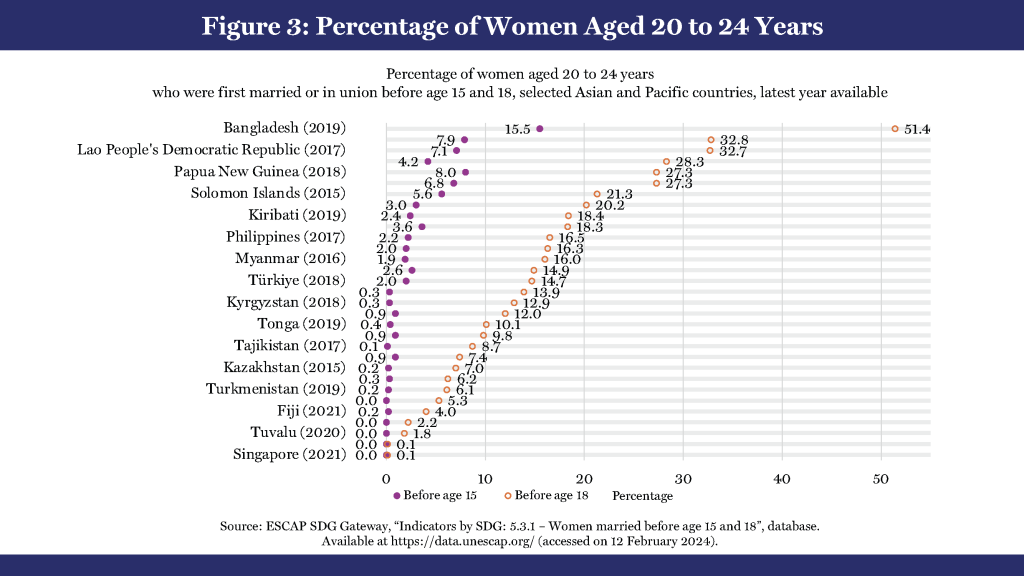
Comprehensive prevention programs to transform the social norms and behaviors underpinning gender-based violence are gaining traction. Such initiatives aim to address the cultural and societal factors that normalize violence and thereby create lasting change. India has made significant strides in reducing child marriage by supporting girls’ educations through conditional cash transfers and providing access to gender-transformative life skills and reproductive health services.
The urgency to address technology-facilitated violence has also grown, as women increasingly face harassment and exploitation in digital spaces. This requires strong collaboration among governments, the private sector and civil society. Legislative actions, such as criminalizing online sexual abuse and establishing mechanisms to address deepfake crimes, aim to improve accountability and create safer digital environments. In the Republic of Korea, the Digital Sex Crime Victim Support Center offers comprehensive support, including counseling, legal assistance and technological support for digital-content deletion to victims of digital sex crimes.
Coordinated, victim-centered essential services are crucial to support recovery and empowerment while ensuring service providers are adequately trained to prevent retraumatization. In Tajikistan, frontline, gender-based-violence, health-service providers have been trained to offer health and psychosocial services, coordinating referrals with other service providers to meet comprehensive needs while understanding national legislations and victims’ rights.
Fiscal policies and financial institutions: key enablers for gender progress
Fiscal policies and financial institutions play pivotal roles in addressing these gaps through gender-smart financing strategies. Prioritizing gender-responsive budgeting ensures that gender considerations are embedded across all stages of planning and budgeting cycles.
Innovative financial instruments, such as social and sustainability-linked bonds and debt swaps, provide additional avenues for directing funds towards gender equality. For example, these tools can finance projects that promote women’s economic empowerment, improve access to education and healthcare, and address gender disparities in climate resilience. Similarly, gender-responsive progressive taxation strategies can redistribute wealth to benefit women and girls.
Financial institutions can lead the charge by shifting from profit-driven to impact-focused investment that channels large-scale capital towards addressing social and environmental challenges. Encouraging gender-responsive foreign direct investment (FDI) and supporting women-owned businesses—particularly micro, small and medium-sized enterprises—through access to microcredit, venture capital and private equity are essential steps to close gender gaps.
Structural reforms, institutional commitments and social changes must accompany fiscal policies and financial investments. Governments and financial institutions must work together to create an enabling environment in which women can thrive in all spheres of life.
The recent Beijing+30 gender-equality review conference in Bangkok reaffirmed the commitment of Asian and Pacific countries to tackling systemic barriers and closing gender gaps in critical areas. ESCAP will continue to work closely with governments, civil society and the private sector to drive bold, decisive actions to promote equity in economic participation, ensure equal representation, address violence in all its forms and embrace the opportunities of transformative megatrends. Together, we can pave the way for a more inclusive, just and equitable future.
References
1 Economic and Social Commission for Asia and the Pacific (ESCAP): “Charting new paths for gender equality and empowerment: Asia-Pacific regional report on Beijing+30 review,” November 19, 2024, United Nations publication, 2024.
2 International Labour Organization/ILOSTAT Database: “Gender income gap, ratio of women’s to men’s labour income,” ILO modelled estimates (Nov 2023), earliest and latest year available.
3 Economic and Social Commission for Asia and the Pacific (ESCAP): “Protecting our Future Today: Social Protection in Asia and the Pacific,” Social Outlook for Asia and the Pacific, United Nations publication, 2024.
4 Economic and Social Commission for Asia and the Pacific (ESCAP)/SDG Gateway: “Indicator by theme: Seats held by women in national parliaments (% of seats) 2000–2024,” database. (Accessed on June 14, 2024)
5 Inter-Parliamentary Union (IPU): ESCAP elaboration based on Inter-Parliamentary Union and UN‑Women, “Women in Politics 2023,” Infographic, Geneva and New York, 2023.
6 World Health Organization (WHO): “Violence Against Women Prevalence Estimates, 2018: Global, regional and national prevalence estimates for intimate partner violence against women and global and regional prevalence estimates for non-partner sexual violence against women,” Geneva, 2021.