

By John Manning, International Banker
As far as financially sound and technologically innovative financial institutions in Europe are concerned, very few tick as many boxes as KBC Group. Indeed, with its most recently published financial results for the third quarter (Q3) of 2024 revealing yet another bumper quarter—net profit was recorded at a mighty €868 million for the period—last year proved to be another vintage one for the region’s leading integrated bank-insurer. And with successful digitalisation and business-diversification strategies at the heart of this stellar performance, the Group’s robust business model is distinctly set up for further gains amid the potentially volatile market conditions anticipated for the months ahead.
KBC’s digitalisation policy—known as Digital First with a Human Touch—has been especially fruitful for the Group in recent years in terms of not only retaining and expanding its customer base but also helping to shape what is possible for digital banking. Among its most effective strategies in this context has been boosting its exposure to artificial intelligence (AI) dramatically, with applications now liberally leveraging the technology to serve customers more capably and fulfil their banking needs.
Kate has become the Group’s go-to application for providing support across the entire length and breadth of the customer journey.This can be most demonstrably observed with Kate, KBC’s hugely impressive virtual assistant, which is utilising AI to improve its powers to assist customers autonomously across a broad and diverse range of needs and requests continuously. Kate has become the Group’s go-to application for providing support across the entire length and breadth of the customer journey.
After this powerful technology was combined with blockchain, the resulting Kate Coin has proven to be a successful among KBC customers. A digital currency that is gained by utilising the Group’s products and those of its partner organisations and can be used to earn cash rewards and enjoy a myriad of benefits from third parties, the Kate Coin is helping customers earn money because of their relationships with KBC.

KBC Group Headquarters in Brussels, Belgium
It is perhaps this combination of technologies and innovative concepts across key applications that is now most effectively distinguishing KBC Group from other digitally minded financial institutions. The likes of Digital First with a Human Touch, Bank-Insurance+, Kate and Kate Coins have been combined into what the Group calls an “ecosphere”. According to the Group’s chief executive officer (CEO), Johan Thijs, such offerings can be compared to jigsaw-puzzle pieces, while the ecosphere represents all the pieces coming together to deliver a cohesive proposition for supporting each customer journey—from idea conception to the fulfilment of the customer’s needs in the form of highly tailored, personalised products and services.
“We can now assist our customers in fulfilling their dreams,” Mr. Thijs recently observed. “For instance, if you want to buy a house, we can assist you smoothly from the moment that you intend to buy until the moment of delivery. This process can now be handled via all our tools—guided by Kate, assisted by Kate Coins and underpinned by our products, such as loans and property-insurance contracts—in such a way that we unburden our customers of all the potential complexity of the process.”
Internally, the Group describes the ecosphere concept as STEM—Save, Time, Earn, Money—which aims to unburden the customer at each intermediate step along the process.Internally, the Group describes the ecosphere concept as STEM—Save, Time, Earn, Money—which aims to unburden the customer at each intermediate step along the process. Whether it’s helping to alleviate the hefty administrative requirements, simplifying potentially complex concepts or providing optimal solutions to help the customer save money, the ecosphere of innovative solutions is there to ensure that working with KBC is an efficient, affordable and uncomplicated experience. “The two major drivers in this whole process are Kate, which is the guide in the customer journey, and Kate Coins, which is the glue that ultimately makes you earn money,” Mr. Thijs added.
What’s more, this ecosphere approach is now garnering lofty accolades. For instance, French consulting company Sia Partners chose the KBC Mobile app as the best mobile-banking application of 120 banks globally. And it’s clear why: While it adeptly performs a broad range of basic banking and insurance tasks, such as executing money transfers, paying bills, obtaining loans and purchasing insurance contracts, KBC Mobile goes well beyond the capabilities of a regular mobile-banking application. Whatever aspect of the customer journey is being undertaken, for instance, Kate is on hand within the app to guide the customer through to the ultimate fulfilment of the chosen product or service.

Johan Thijs, CEO, KBC Group
Such integrated and effective support has also helped to spawn more useful products for customers. A particularly appealing one that has been launched recently and tested on 300 to 400 customers provides essential support for home renovations. For example, when KBC works with third parties to help customers install solar panels, photovoltaic towers or heat pumps, the entire journey is fully serviced by Kate. What’s more, Kate Coins are also integrated into the process. “The customers are actually only involved in taking the decision to go ahead and signing the contract,” Mr. Thijs also acknowledged. “And all the rest of the work is done by Kate via KBC.”
Another example shows KBC proving itself helpful in reducing customers’ energy bills. This solution involves customers selling the surplus power generated by their solar panels to energy companies and other individuals, who can then sell it at higher prices. Kate performs all the administration and intermediation linked to this process, efficiently enabling customers to make great savings on their electricity bills.
It is because of such cutting-edge solutions that KBC Group is widely lauded. Its reputation as a financial institution that commands some of the most stable and healthy financial-performance metrics is justifiably augmented by its relentless desire to use a cutting-edge ecosphere of technologies to enhance the customer experience. It can now rightfully claim its position among the world’s true digital-finance pioneers.
To discuss more about KBC’s digitalisation successes and much more, we welcome Mr. Thijs. Thank you for joining us today….
KBC Group reported a stellar net profit of €868 million in Q3 2024 but also registered robust performance across the first three quarters of the year. What do you see as the main factors underpinning this strong performance?
It is mainly down to our business model; as a financial institution, KBC is what I call “double diversified”. In terms of geographical presence, we have business activities in Western Europe, with Belgium being our main market. We also have activities in Central Europe. And in terms of GDP (gross domestic product) growth, interest-rate positioning and our presence in euro countries versus non-euro countries, we are perfectly diversified.
The second diversification is via the 50-50 split of our revenues between interest-bearing assets and non-interest-bearing assets (such as our fee- and commission-based insurance and asset-management businesses). This 50-50 split was also in place three to four years ago, when central banks such as the ECB (European Central Bank) were implementing negative policy rates.
Since then, those rates have increased, which has boosted our revenue from interest-bearing assets and thus put upward pressure on our net interest income (NII). Nevertheless, if you look at the Q3 2024 and January-September 2024 results, the balance between interest-bearing income and non-interest-bearing income remained at 50-50. So, we were able to match the steep increase in interest income with a similar income increase on the insurance side and the fee and commission side.
KBC also delivered a very strong performance in terms of inflows of volumes, loans and deposits. We have been able to invest those deposits using a replicating portfolio with a view to strengthening our long-term PNL (profit and loss). This clearly paid off in 2024, and it will also do so in 2025 and 2026.
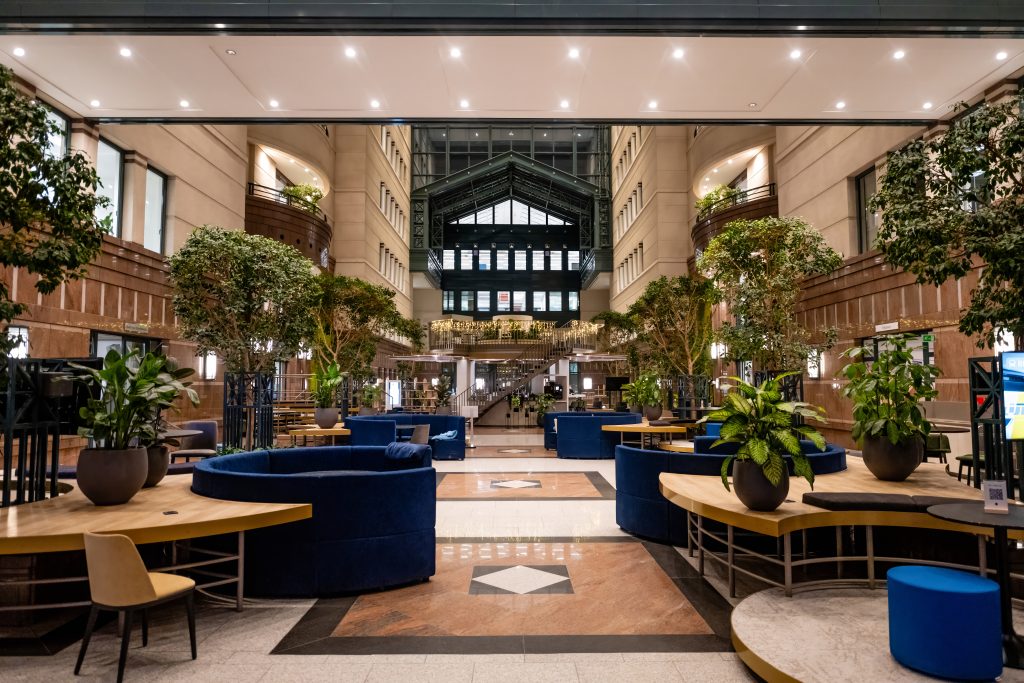
KBC Group Headquarters in Brussels, Belgium
Speaking of deposits, Q3 saw them rising by 5 percent quarter-on-quarter and by a hefty 8 percent year-on-year in the Belgian market. How do you explain these solid growth rates?
Well spotted! This was mainly due to a particular occurrence within the Belgian market. In September 2023, we were faced with customers investing in a Belgian state note issued by the Belgian government. The note ended up collecting €21.7 billion from domestic private investors—including a €5.7 billion shift of customer money from KBC—despite an initial target of just €2 billion.
The note matured in September 2024, launching a fierce competition between all banks in Belgium to recuperate their monies at this maturity date. From this perspective, KBC did a tremendous job because we collected €800 million more than the €5.7 billion that left the company.
The other crucial factor underpinning this strong growth in deposits has been the distinct attractiveness of KBC as an institution for customers, which allowed us to collect far more deposits than in the same period a year earlier. So, we had a double positive effect—the recuperation of the state-note money and customers entrusting us with more money than they did the year before.
If you look at what we call “core customer money”—that is, all kinds of deposits and asset-management products, investment products and life-insurance products—then KBC enjoyed a very strong first nine months, collecting around €15 billion more than the year before. And if you look only at Q3, which was positively distorted by the collection of the state-note money, we collected €8.7 billion in total—a very significant amount.
As you know, we like to stay up to date with the progress of Kate, your AI-powered virtual assistant. Are you satisfied with the progress Kate made in 2024 in learning and successfully responding to customer queries? A year ago, you told us that Kate answered 56 percent of customers’ questions. Has this number improved since then?
Saying that I’m pleased with Kate’s performance is an understatement! We are exceeding our own planning, and I would say the results are now even beyond our greatest estimate. Without any human assistance, Kate can autonomously answer around 70 percent of all customer questions. That’s more than two-thirds of all customer questions being answered and fulfilled by Kate as we speak, and that is indeed very significant.
Kate’s success has had a huge effect on many elements—customer satisfaction, to mention one. But also, in terms of our productivity and our revenue power, five million of our customers have now been in touch with Kate for now and using “her” as a true alternative to our employees in our branches.
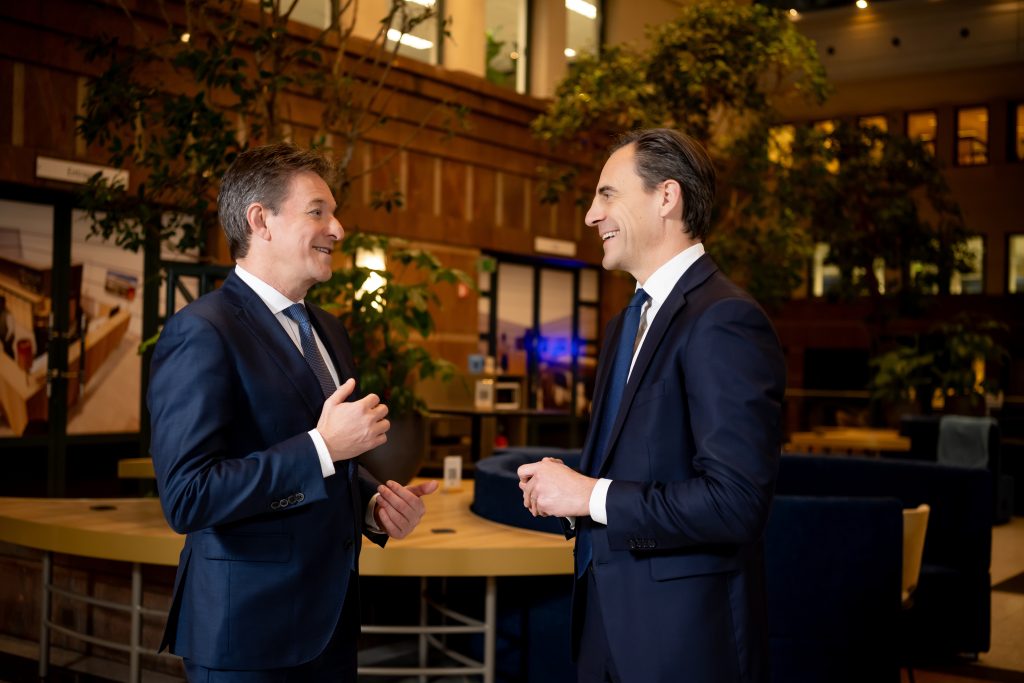
Johan Thijs, CEO, KBC Group and David Moucheron, CEO of the Belgium Business Unit, KBC Group
That’s hugely impressive. And in which areas would you say Kate is now performing best in terms of the types of questions being asked of it?
So, I would say that all the simple questions, such as “I want to increase my payment limit”, “Kate, please show me my PIN code or Kate, what is my account number “all these things are 100 percent dealt with via Kate. And more importantly, the customers are now aware of Kate’s capabilities and are heavily using it for such purposes.
The second area is the super simple products, where Kate is performing autonomously without customers having to refer to our bank branches—to our human side. As an example, instalment loans, which are mostly used to buy cars or to refurbish houses, are now mainly dealt with via Kate without human intervention; whereas three or four years ago, all such queries were directed to employees in bank branches.
Another example is on the insurance side, with customers increasingly using Kate for claims notifications. A major windstorm in Belgium at the end of 2023 saw roughly 12,000 claims being requested; KBC received notifications of 6,000 of those claims via Kate within 24 hours. What’s more, they were confirmed in callbacks to our customers, and their respective administrative processes were completed via Kate for KBC Insurance without any hassle.
Wow, those results are certainly supportive of AI’s effectiveness within the industry. That said, the European Union’s (EU’s) Artificial Intelligence Act (AI Act) came into force on August 1 to support the development of trustworthy AI across Europe. How impactful has this landmark legislation been on KBC’s digital and AI ambitions? And in what significant ways is KBC now mandated to comply with the AI Act?
KBC has already been using AI for many years. And because we’re a frontrunner, we have been a little ahead of the regulations issued by the European Commission (EC). So, if you are a frontrunner in innovation within financial services, you need to be aware that regulation will follow innovation.
Such regulation does not necessarily take into account what a certain innovation has been delivering thus far. Moreover, it creates a lot of red tape and administrative burden, in other words a lot of human energy just in order to comply. And given that such legislations are binding, it means we often have to change our processes or our products. Indeed, the AI Act is just one example of such regulation.
Another example of legislation that is hampering innovation is the Mica Regulation, which has an immediate impact on how we deal with our Kate Coin and, for now, has only been partly implemented. Again, KBC is a frontrunner within the European market in this area. So, each time that these kind of legislations come into play, it creates a lot of uncertainty for all involved stakeholders and we have to comply with the regulation and report to regulators. This is the fate of being very innovative and a frontrunner.
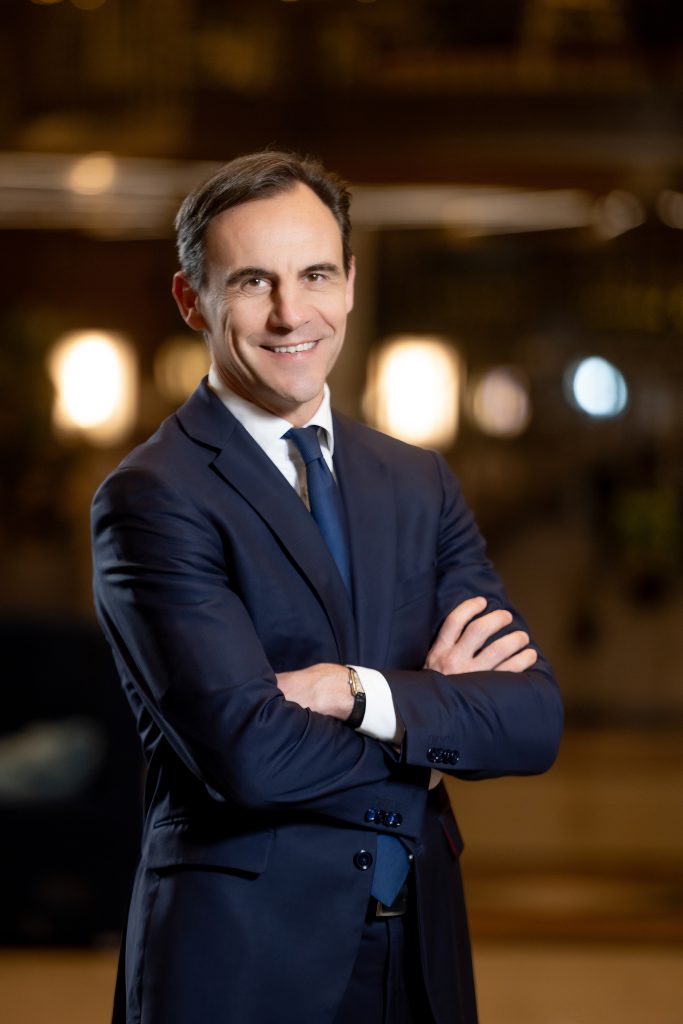
David Moucheron, CEO of the Belgium Business Unit, KBC Group
David Moucheron became a member of the Group’s executive committee and CEO of the Belgium Business Unit in 2021. In the three-plus years since then, what have some of the unit’s greatest accomplishments been under David’s leadership? And what has David’s toughest challenge been during this time? How has he addressed and resolved this challenge?
In KBC Group, the individual is not as important as the team. So, David and I are cogs in a bigger machine. The Business Unit in Belgium is still the biggest entity within KBC Group and part of the total success I referred to. And that has been dealt with by a lot of people under the guidance of David Moucheron, who is assisted by a lot of people, amongst others, people on the KBC Group executive committee of which David is also part.
Let me give you one example. Kate, Kate Coins, ecosphere—the whole thinking about that concept is done here at KBC Group’s headquarters. And that is uniformly translated Group-wide. And then the likes of David are implementing that with the different flavours typical for the countries in which we are present. So, Belgian flavours are tweaked compared to the Czech and Bulgarian implementations.
If you look at the results, David and his team have been doing a great job. Belgium has been delivering excellent results. We have seen strong growth in the number of clients. To give you an example, on a yearly basis, we grow the number of clients. It’s comparable to the size of a midsize city in Belgium. Roughly 100,000 extra customers a year come in. We have certainly improved the productivity and efficiency of our operation. We have been implementing innovation. Kate has been integrated further into the mobile-banking app, which has become the number one mobile-banking app in the world. We have been launching ecosphere initiatives.
David has been in that role for three years. So, we have had a couple of challenges since then. We had COVID. After COVID, we were confronted with the Russian invasion of Ukraine, which triggered a lot of inflation and uncertainty. After the high inflation, we had a steep increase in interest rates, which also triggered the Belgian state to interfere with the state note. Despite all these external challenges, the team has dealt superbly and has created the best-performing financial institution in Belgium that has been nominated by a lot of external assessors like you. And consequently, not only you but also others have concluded that KBC Bank is by far the best-performing bank in Belgium, not only for the last year but for most of the last six, seven or ten years.
“KBC Economics” is an interesting avenue for publishing the Group’s macroeconomic views and trends. What are some of the key macroeconomic projections that “KBC Economics” has published for 2025 (for example, its view on euro area inflation moving forward, interest-rate movements for the year and so on)?
You have touched upon a very important topic because, on both the banking and insurance sides, the Group is working in an environment that’s constantly influenced by geopolitics, economic growth, inflation, etc. As such, the projections being made by my economic team under the guidance of Hans Dewachter, my chief economist, are of crucial importance to us.
Let’s face it; it’s not a precise, exact science, like mathematics, but rather a social science. Therefore, it’s always a big challenge to find the right conclusion. Over the last few years, the team could quite precisely predict the forward direction of economic growth, inflation and, consequently, the decisions taken by central banks regarding policy rates. This is crucial for us because, as a financial institution, we have to position ourselves ideally amid the broader macroeconomic environment.
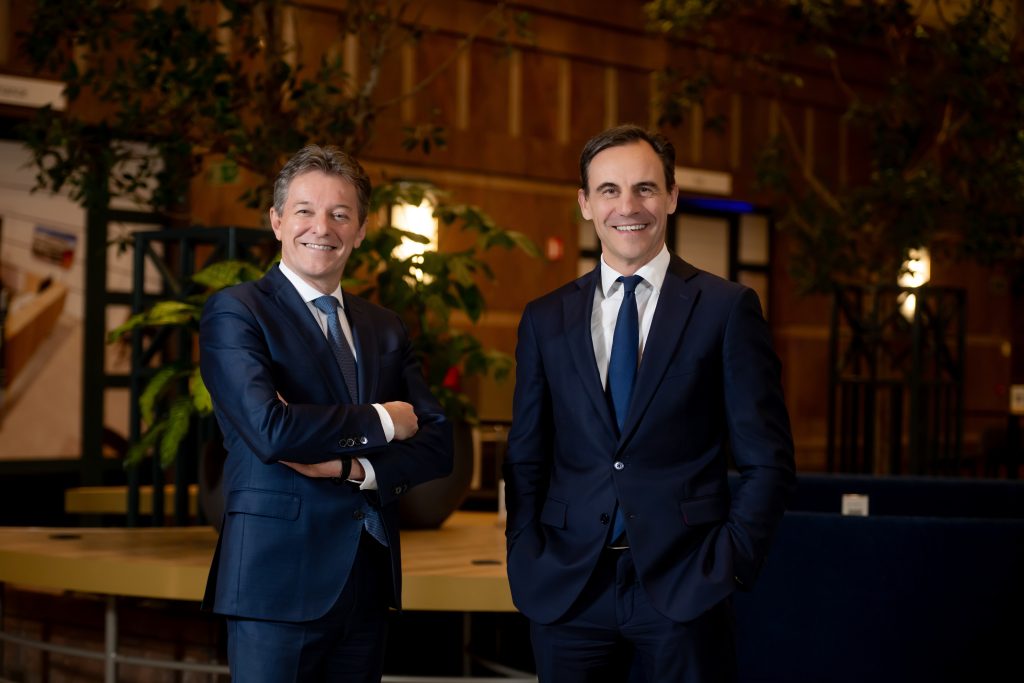
Johan Thijs, CEO, KBC Group and David Moucheron, CEO of the Belgium Business Unit, KBC Group
KBC’s recent success can, therefore, be partly credited to our accurate assumptions and forecasts for economic growth, interest rates and inflation, which have proven quite correct compared to the unfolding realities.
This year, a lot of elements will create volatility in the market, including the reinstatement of Mr. Donald Trump as the US president. Given that he speaks about tariffs, putting a hold on migration and even expelling illegal immigrants, as well as potential implications from his budget and so on, his presidency will have an impact on the global economy and, for sure, also the European economy. And irrespective of the directional impact, the certainty is that there will be volatility.
From this perspective, our economic team thinks that inflation will not go away. And while interest rates were cut repeatedly last year and will continue to come down in might even increase in 2026 as a consequence. There is a lot of uncertainty ahead of us, which will keep economic growth under pressure.
The short- and long-term forecasts that were made, say, half a year ago for interest rates and inflation are not necessarily correct and are constantly updated based on newly available information.
Finally, what do you expect the Group’s single biggest challenge to be in 2025? What do you anticipate will be your own most significant challenge as Group CEO and a banking leader this year?
I think that going forward, the uncertainties I just mentioned will start to materialise in the coming weeks. The pledges of Trump’s election campaign will now come to concrete implementation.
Now, given that implementation and the impacts on the global and European economies, my biggest challenge is to anticipate how we can deal with that within our bank-insurance environment. We then must make sure that within that environment, we are going to optimise delivery to our customers, especially via the implementation of our ecosphere strategy.
So, to summarise, in an uncertain world with a lot of challenges, keep a cool head. And make sure that our customers are perfectly served and that at the end of the year, all our stakeholders, including our shareholders, are very happy with KBC.
I’m sure that your customers and stakeholders will continue to be hugely satisfied with KBC this year. Mr. Thijs, thank you for your time today.